For Cog Tools, the Cadre is adopting three video games in which they will play consistently over the course of the month. One has to be a single player game, one a massive multi-player game (or MMO), and the third has to be a “potty game.” Yep, you heard it right. A potty game. If you did a quick Google search for “potty game” you would be remiss that it contains a different definition than ours. Google would tell you that potty games exist to teach you how to go to the potty. Not the case in MALT. For us, a “potty game” is simply a game in which you are most likely to play on the potty–meaning it is probably on a mobile or tablet device. These games also have a similar game play styles: usually of asynchronous puzzles or stages in which are convenient for you to leave and come back into at any point. After taking a quick glance around the open web, I can’t come up with a single article that refers to this style of game as a “potty game,” so, Bill Moseley, I believe this incredibly scientific term is yours for the taking.
Jane McGonigal, author of Reality is Broken, refers to them by a slightly more sanitized name, casual games, which is “an industry term for games that tend to be easy to learn, quick to play, and require far less computer memory and processing power than other computer and video games.” She points to a survey of high-level executives that revealed that 70 percent of them regularly engage with casual games while at work through quick game breaks to make them feel “less stressed out.”
This makes perfect sense–casual games are undoubtedly more effective than more passive ways of decreasing stress at work, like browsing the Web. By tackling an unnecessary obstacle in the middle of the workday, these executives are triggering a sense of self-motivation.
– Jane McGonigal, Reality is Broken
Personally, I don’t engage incredibly often in these types of games. My “casual game” is usually checking my Twitter or Instagram, which allow me to quickly engage with other facets of my life. So, needless to say, I’m due to 1.) find a game or two on my phone I could enjoy and 2.) find out if having these types game do play an influence on how I spend my breaks at work. I do believe I’m certainly more likely to pop in and out of casual game than I am an MMO.
Enter Plants vs. Zombies. This was a game that was initially suggested to me via another Cadre, and then reaffirmed by coworker of mine who simply referred to it as “PvS.” My guess is if your game has an affectionate acronym, you’ve done quite well. 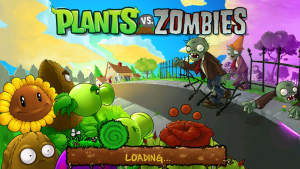 Plants vs. Zombies was developed by PopCap, a video game developer based out of Seattle, Washington. PopCap was first recognized for the development of Bejeweled, which my wife is greatly fond of. They’re also the makes of Peggle, which I know a few Cadre members are playing as well. I learned some interesting factoids about the company while perusing their Wikipedia entry: 1.) They got acquired by EA in 2009 for a cool $650m. Not bad for three dudes who made a game where you swipe jewels. 2.) They have a history of developing on multiple platforms, but, smartly in my opinion, shifted their focus in 2009 to a growing trend in free-to-play, mobile casual games. EAs acquisition was looked at a way for them to compete with Zynga, makers of mom’s favorite pastime FarmVille. How smart was latching on to mobile in 2009? Zynga finally released a mobile version of the game in April 2014 after sticking way to look with an exclusive partnership with Facebook.
ANYWAYS, let’s just say hopes were high considering this title is from one of the titans of casual games. I grabbed it for 99 cents and was quickly on my way. The first thing I noticed was how quickly I got to gameplay. I was asked to simply enter my name to create a profile (in case multiple players want to play on the install) and was then subsequently moved into game mode. In all honesty, the transition was so quick that I actually thought I was just playing a tutorial, but this would prove to be false. 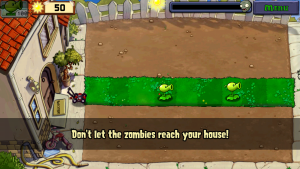 The overall objective is to stop zombie’s from invading your house. Sounds simple enough. You will complete this task by planting various plants which ward of zombies through various tactics (usually seed spitting and self destruction).
But Plants vs. Zombies is a game that gives you only the directions you need for the time being. So we’re starting out simple. I have a plant that can spit seeds at the attacking zombies. Zombies are dead. Level is complete. Of course, with level completion comes a new level of difficulty and with a level of difficulty comes a new tool of my garden. 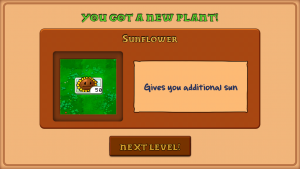 I have earned the power to now deploy sunflowers. Sunflower are not offensive but, rather an investment in future offense. Sunflowers absorbs solar energy which it converts into sun coins. Once you’ve gathered enough sun coins, you can buy more spitter plants and deploy new weapons (or new sunflowers if you so wish). Almost immediately, my strategy shifted as I now understand the immense value. This is reinforced by a banner message which says “Sunflowers are an extremely important plant.” Noted.
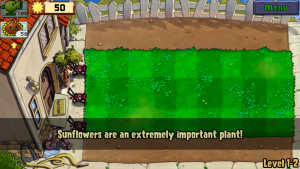 As you subsequently complete each level, you are given a new tool. A cherry mine which is an incredibly powerful tool destroying all zombies within a short radius of where it detonates. A potato mine, a land mine that explodes on contact. A “wall-nut” which is a defensive plants. The only zombies which can get by the wall are these zombies will pole vaults. It’s as if they knew…
Shortly, you have more tools than you have slots in your toolbox and you have to choose. Do I take the Snow Pea which slows down zombies through its freezing abilities or do I take the Chomper which can instantly devour a zombie but takes a while to digest it? Suddenly, you’ll have more tools than you know what to do with.
There’s also a humor to the app, which I would assume you would come to expect when the premise is saving humanity from zombies with plants. After successfully completing a few rounds, you meet Crazy Dave. Crazy Dave wants to do a different activity just for the shear sake of being crazy. He has this idea that we should just bowl down the zombies with the wall-nuts. I laughed out loud at his rationality: “Why? Because I’m CRAAAAAAZY!” In my head, I imagine that the developers purposely embedded their culture into the design. They want you to understand the silliness of the objective. I see this conversation that says “Hey you know that goofy character that you were sketching up that we joked and called Crazy Dave? Let’s integrate him in somewhere… Now people are going to think that we are totally diverging from the game original objective, which we definitely are, but that’s the whole point of Crazy Dave. He is a reckless abandon.” 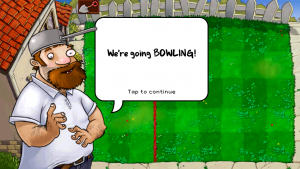 Beyond Crazy Dave, I think my main takeaway from the experience was this:
Gameplay transition is so fast its actually hard to peel away in comparison to other games. OF COURSE you want to play the next round when you are partly motivated by testing out the new plant weapon. And when you get a new weapon each and every round you complete, this can turn into a dangerous cycle. I caught myself going “Huh… I wonder what a good use case for this weapon will be,” and ignoring my crying baby. “I bet the baby stops crying during THIS level.”
There is something to learn here that applies to learning design. Successfully completing a “level” shouldn’t simply lead to a new task with a greater level of difficulty. Rather you can also complement the new difficulty with a new too. Sure, it’s harder, but you get something new to play with… I teach a course in our College of Journalism that essentially gives students a crash course on Photoshop and InDesign. During the first few weeks, I show them all the tricks of the programs. 1.) This is too overwhelming for most novices and 2.) They forget it by the next class. My students only retain the knowledge when they have a clear understanding of the specific use case of that tool and can immediately apply it. What if there was a version of Photoshop were you could slowly release the functionality of the toolbar but starting out you simply had a mouse, the type tool, and a color picker and students EARNED the opportunity to try the others as well? Photoshop vs. Pixels?