In my last post, I went into some of the cognitive science research that has came out of videos game. Specifically, what chemically happens to people taking video games and how that can differ between gamers in non-gamers. Essentially, I had let science decide my fate of enjoying or not enjoying video games.
About a week ago I started playing my third and final game of the three game challenge, Portal. Portal serves as my single player game and I have to say, I’ve really, really enjoyed it. It’s essentially a puzzle game set in the first person shooter universe.
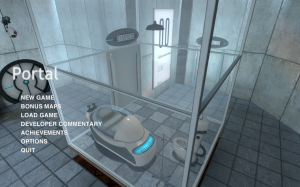
You wake up in what looks like a hyperbaric chamber with an automated voice talking to you. Not very often does this voice give you very good directions. In fact, sometimes the voice’s go is to purposely throw you off your game by talking overly negative or calling a test chamber impossible. Somehow you come to understand and love the voice’s sarcasm. After all, in a world where you seem to be the only human, you can become attached to anything you feel you can interact with.
The objective is to make your way through 19 test chambers in this abandoned research facility. Per normal game theory, levels at the beginning of the game are not complex and can involve merely moving a cube on top of a button that releases a door to complete. Some themes I’ve noticed:
1. Simplicity
Slowly throughout the levels you begin to understand new ways of completing tasks. Your only tool is a portal gun which allows you to create shoot two doors in which you pass through the other and vice versa. It’s fun to see a gun used for a single use (particularly not as an actual gun). This really gives the game a unique feel and sets it out from the first person shooter games which usually require you to leverage multiple weapons.
I also noticed how sparse the levels are with decoration. There aren’t a lot of over-the-top graphics of scenery that distract you. For the most part, rooms are empty and the end goal is clear and focused.
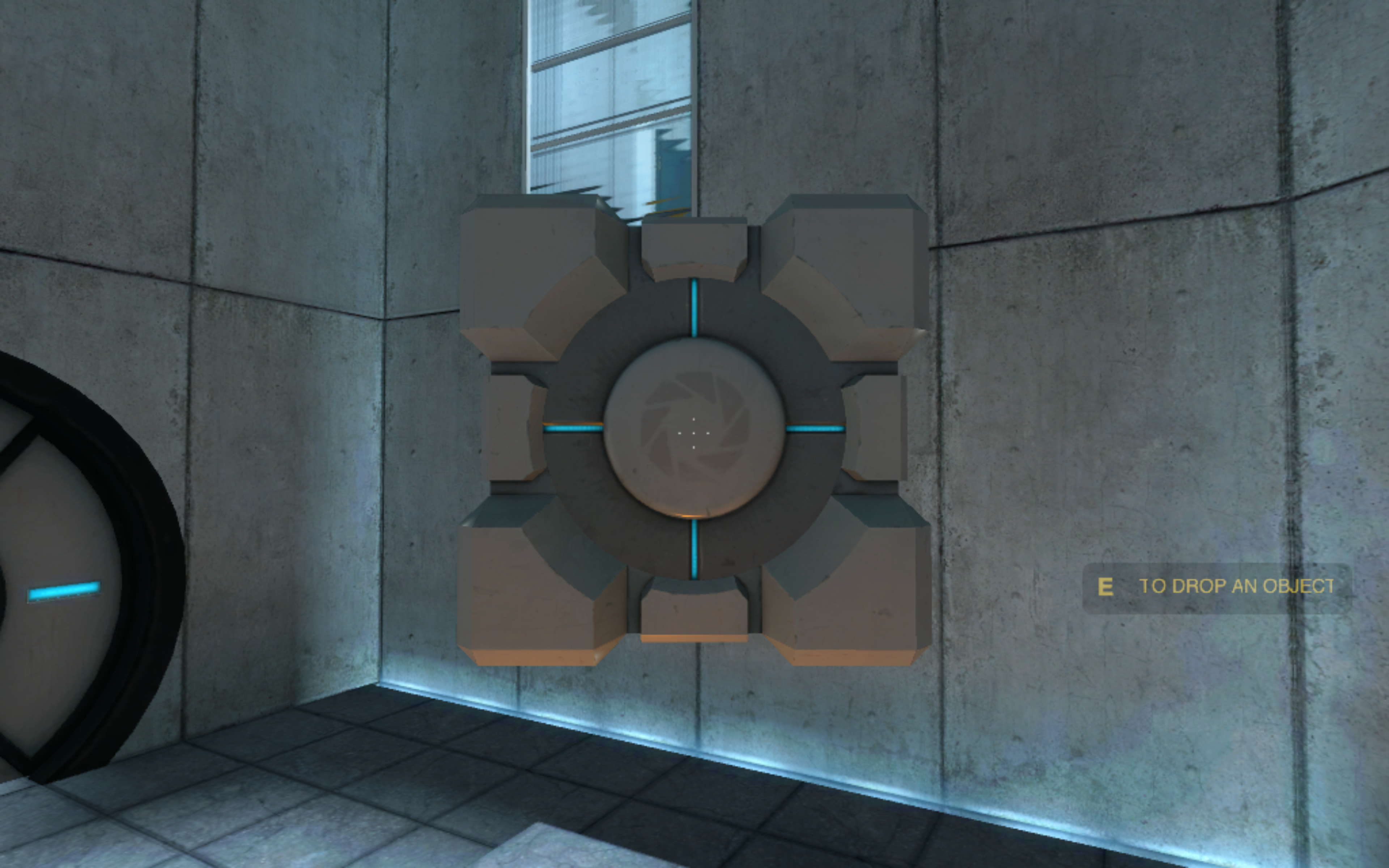
Last, the directions are simple. You learn what you need to know as you go and you receive a simple little message telling you how to complete the task. For instance, I received this message the first time I needed to pick up an object.
 2. Directions are sparse, even misguided. And that’s okay.
I mentioned this above but the voice who is telling about gameplay is never quite clear. She dances back and forth between being positive and encouraging and sinister and sarcastic (to the point where you are leery about what exactly makes her happy when you do complete a mission. She has to have some reason for wanting you to complete it, right?). But while this can feel misguided, it can still have a positive ending. For instance, in one level she tells you that if you die (even once) you will not be able to complete the mission. Needless to say, I was purposeful in every step I made as to make sure I indeed did not die. Once you finish, she lets you know that telling you that was merely part of the test and not true. In fact, frequently she tells you something she told you wasn’t true. But it makes you a better player when you learn to play within the unnecessary obstacle. Jane McGonigal says this about games:
Playing a game is the voluntary attempt to overcome unnecessary obstacles. – Reality is Broken
In the sense of Portal, even the directions can be the obstacle. The idea I’m about to explain is half-baked, so please entertain me while I try to flesh this one out, but here it is. I am kind of enjoying not exactly knowing what my objective is, where I’m going, where I’ll end up, and if my voice/teacher/lone friend is really on my side. Yet even if the end of the journey is that I self-destruct and my voice friend has turned me into a superhuman in which she can exploit for her own purposes I won’t necessarily be mad because I still have felt a sense of accomplishment by completing the game.
In my world of higher education, you are not only given the road map but you begin planning for the “hard levels” (mid terms, papers, finals) all the way from Day One. In fact, the only tangible requirement for every instructor is the syllabus. The road map. What journey could you take a student on if they could voluntarily decide to join you and where could say, “Trust me–I know where we are going. I’m purposely not going to tell you much more than a few steps ahead. But I promise that where we end is going to be worth the journey.”
One Comment