Today I did it ladies and gentlemen. I beat a video game.

And it felt good. I felt a sense of accomplishment. Though I feel like it was less of an accomplishment because Corey and Landon apparently beat its sequel Portal 2 in one sitting.

The short play-by-play was something like this. I had came upon Chamber 19 and was excited to finish the last level (though I had a hunch that 19 was not going to be the very end given the oddity in the number).
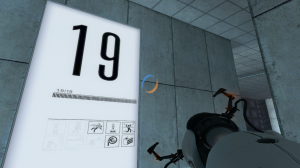
As I finish the level, the voice that has been guiding me through the entire game began to tell me that I had done a very good job and now all machinery must be destroyed. This meant jumping on a conveyor belt that was plunging me towards a fire pit.
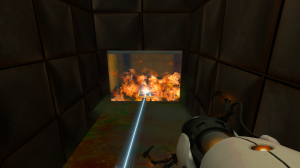
I’m not quite sure why but my immediate reaction was to save my character. We couldn’t go out like this right? This game is all about creative problem solving when you think no answers are left and this situation was just another opportunity to leverage the skills I had acquired over the game. While most of the game I proceed in game attempts with slight caution, for this one I had a quick reaction time and was successful in saving myself for ultimate doom.
Why was I so quick to want to save my character? This would be what James Paul Gee calls the projective identity. Notice first that I keep saying “my character” meaning I don’t identity myself as the main identity but rather I’m identifying this virtual identity. And ending the game by seceding to this voice is not how I would expect my character to go out. It’s grown and it’s defeated all of the necessary test chambers to do whatever characters would normally do after completing test chambers. Gee talks about this feeling in What Video Games Have to Teach Us About Learning and Literacy with a game he plays called Arcanum:
“The kind of person I want Bead Bead [his character] to be, the kind of history I want her to have, the kind of person and history I am trying to build in and through her is what I mean by a project identity.” – James Paul Gee, What Video Games Have to Teach Us About Learning and Literacy
As I landed on the other side it was somewhat of a metaphor for what was about to happen. The objective was now to save myself from the voice that had been guiding me this entire time. This was a more extensive sequence than I was expecting. Having only experience with “boss” like endings such as Mario, I was just expecting to find my Bowser in the adjacent room as if he was just a wizard behind a curtain. But this wasn’t so. I spent another hour escaping room after room of this empty research lab while all the while the voice is taunting me about how we could have just ended it and been eating cake. Side note: I’ll be honest, I never really understand the point of the cake, but it meshes really well with the slightly off British-like/Canadian-like humor of the rest of the game. Anyways, I keep coming across messages like this:
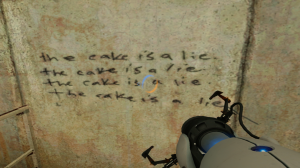
Let’s just say if I had ran across this on a Yelp ad this would not be my first choice for post-date dessert.
Finally, I make it to a room where I get to meet my maker. I am put on a timer in which I have five minutes to destroy it. I fail to do so the first several times I attempt to (I won’t put that on here for fear of your snickers) but eventually I defeat the voice that’s been watching over me in a somewhat reluctant manner given we’ve grown close over our six hours together. As the machine is destroyed, the world becomes a bright light as if I’ve symbolically ascended into a heavenly realm. I travel through a sea of tubes and end up outside in broad day light haven escaped the lab. Eventually I’m presented with, as only one could imagine:
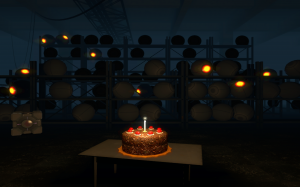
CAKE. Seriously. Seeing some of my tools in the background (such as that cube) leads me to suspect that this is a “Bonus Map” which I saw pop up on menu bar now when I load the game. But I have to be honest. I’m about spent and feel accomplished enough to call it a day with Portal. Dare I say, I’m happy to just have my cake but not eat it too.
Things end with the credits scrolling and my voice friend singing a quirky song to me about how she’s secretly proud of me even though I killed her because I was able to do so.
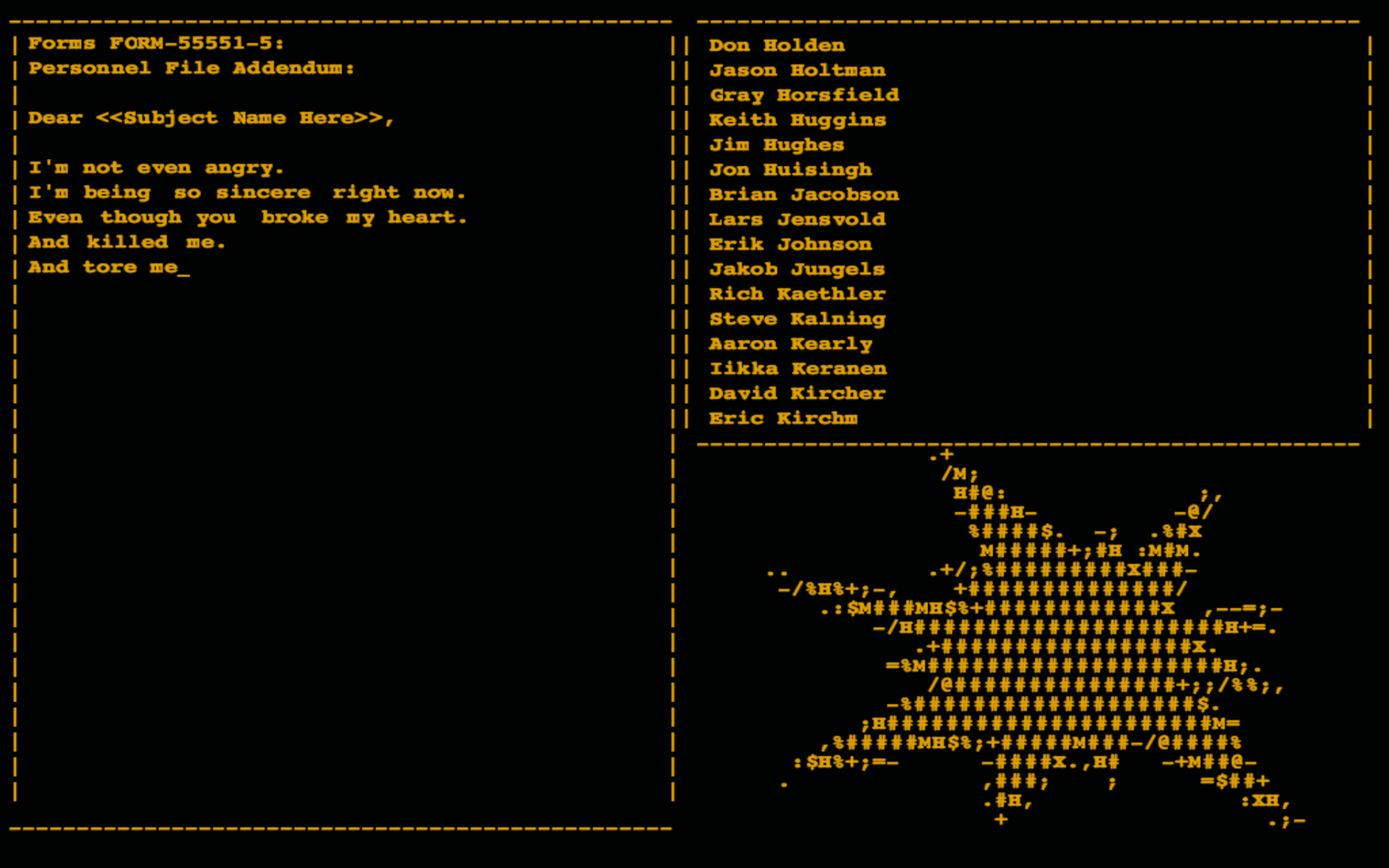 As all of this is happening, I felt a sense of pride. In fact Jane McGonigal has a great word for this feeling: fiero.
“There’s one more important emotional benefit to hard fun: it’s called “fiero,” and it’s possibly the most primal emotional rush we can experience. Fiero is the Italian word for “pride,” and it’s been adopted by game designers to describe an emotional high we don’t have a good word for in English. Fiero is what we feel after we triumph over adversity. You know it when you feel it—and when you see it. That’s because we almost all express fiero in exactly the same way: we throw our arms over our head and yell.” – Jane McGonigal,Reality is Broken
Brian Burke uses a similar term in Gamify which is “flow,” a term that has roots in positive psychology. I know this can be accomplished with learning too. I can’t say I felt this when I would get a report card. The feeling I got from that, even when they were good grades, wasn’t really fiero, or pride, as much as it was just relief. Maybe it was because those letter grades feel so permanent and haunt you forever via your transcript. I did get this feeling though taking a free course from Harvard on edX. The letter grade I made would actually translate to a C but I felt so proud that I had actually completely finished a Harvard philosophy course and it didn’t really matter too much because I would get the same Certificate of Accomplishment no matter what my grade was (as long as it was above a 60). So why did the free course and a video game give me a sense of accomplishment that my undergraduate courses never did? I have two thoughts:
1. This one was on my terms.
Multiple books we have read mentioned that a fundamental aspect of a game is that it has to be voluntary:
“In effective gamified solutions, players opt in to participate, and once they do, they make choices about how they will proceed through the challenges to achieve their goals.” – Brian Burke, Gamify: How Gamification Motivates People to Do Extraordinary Things
I chose that course because I was genuinely interested in the material and I chose this game. While I was playing to fulfill a more formal education experience, the fact is that I have slightly more ownership of it due to the fact that I decided to play this specific game.
2. I was able to easily keep my progress
I talked about this in an earlier post, but this one really is huge. The game felt much more manageable always knowing how close I was to that 19th and final Test Chamber. I was able to give a rough gauge at all times on how much longer the game was going to be. This led to micro bursts of fiero where I could say “Hey, I just sat down for half an hour and cranked through four test chambers.” This is similar with the edX platform where I have an idea of how far I am. Grades are not just a spreadsheet but they are also a bar graph:
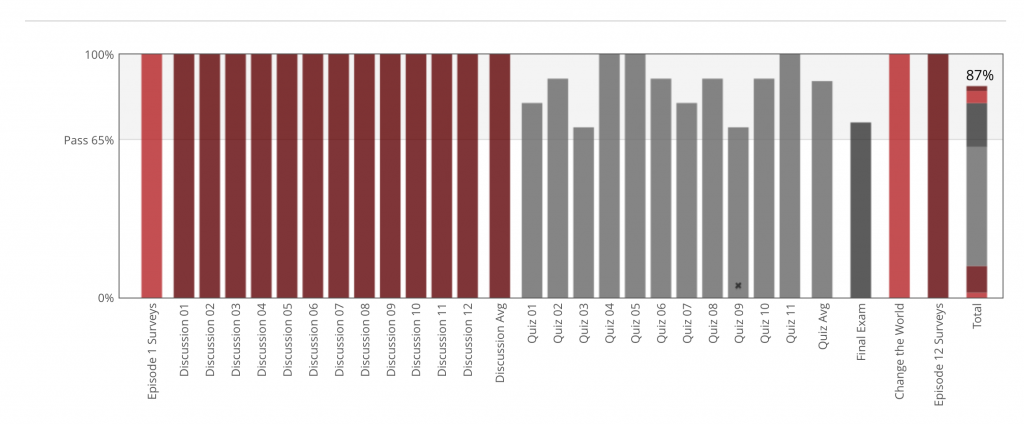
When you focus on the final grade, even midway through the course, you aren’t focusing on built progress towards an end goal. Rather you are focusing on the end goal at all times and can easily miss what’s being picked up along the way.
So there we have it. Portal achievement unlocked. Actually that isn’t true at all. According to Steam, I apparently have only unlocked 4/15 achievements and have some bonus maps to work through. But it’s quite amazing how good 26.67% completion can feel just because its considered completion.