Alrighty so some setup about the idea. First, the major points I’m trying to make are:
- People learn by being able to connect new ideas with prior learning experiences
- These are amplified whenever you can connect ideas in multiple contexts (books movies, the internet, conversations life experiences, etc.)
- You can support fostering this in the classroom, but this is usually discouraged because school’s inevitablely promote individual success (via grades), not group success. Ideas include:
- Allowing students to have the opportunity to create shared experiences that may sometimes not even have the exact desired outcome the instructor anticipated
- The instructor being less defined as a subject matter expert and as a connector of multiple links–more like a librarian
- Encouraging multimodal interactions with learning objects
So the plot premise for Think-A-Thon is that a student feels that he could create a better learning experience than what his university offers. He also explains his role as the curator, which is an allegory for his idea of an instructor. Thus, he holds an event called–you guessed it–“Think-A-Thon” where he aims to challenge himself to create a more successful learning experience than a traditional classroom by simply bringing together people who share knowledge with each other and create new experiences (allowing folks to connect new nodes to each other).
This theory came from multiple experiences both personally and through formal education that I’ve had. I wanted to answer my own question of how do I usually informally learn something I am passionate about, which I believe is close to Bill’s “hard fun” notion. Second, I wanted to think about how a formal environment could reflect that and could it happen at institution-wide. In the end, it veered towards manifesto-like where I felt the only way for an institution to move in that direction, it would require an almost massive uprising of the student body.
So the big question: How successful could an event like Think-A-Thon be? I’m not quire sure. I’ll be honest: The idea is a little half baked and hippy-ish but I think it gets across the message effectively: formal classrooms simply don’t give enough space for someone to explore something they are curious about. Instead we direct them towards our intended “learning objective” and strive for mass assessment of that objective. In the end, the thing you learn best is how to be successful at assessments.
The How
Honest point number two: this assignment didn’t come very easy to me. I struggled back and forth on how to put into words my ideas. And while I did some research into theories that exist, I purposely tried to keep it as minimal as possible so that I could display a raw version of my own learning theory while also reflecting on how well we are doing at promoting it. While I would jot things down in my notebook from time to time, I found myself never being able to come up with a single cohesive idea.
I decided to finally remove myself from simply writing a theory and instead decided to tease out its persona through a separate medium. I decided to reverse engineer it a bit and give myself parameters. I knew we were thinking about these being roughly two minutes, so I went on a search for two minute songs. I went to Audiojungle and searched for songs that were around two minutes long and landed on Health, Happiness, & Success. I pulled the audio file into Garageband and started to break up the song into “scenes” which turned out to be five. All the sudden, my parameters started dictating the structure and it started to finally come alive.
The willing and even enthusiastic acceptance of competing constraints is the foundation of design thinking. – Tim Brown, Change By Design
“Creativity loves constraints” – Tina Seelig, inGenius
Having this chunked approach made the learning theory more manageable. It was less about trying to convey one idea and more about verbalizing five different parts:
- Interaction between professor and student
- How we learn
- How traditional classroom models are ineffective
- The role of the instructor
- The importance to society
I wrote in recorded the audio in an evening now that I had a solid framework. These Coming from the music background, it was now much more like writing lyrics to a song rather than writing a speech. This was recorded with a cheap little Blue Snowball USB mic I found in the office. While it came out with a nice sound, I wasn’t able to gain up the input so I had to basically put my lips on the mic to get a loud enough level. This killed all the natural reverb which I had to insert back in in post.
The last part of the audio was finding some background noise so it had a very natural, ambient sound, so I found some sights with stock background music that worked really well. Those include:
- Crowd Outside 1 (PavDV.com)
- Party Crowd (PavDV.com)
- School Yard (PavDV.com)
- Large Stadium Sound Clip (Soundbible.com)
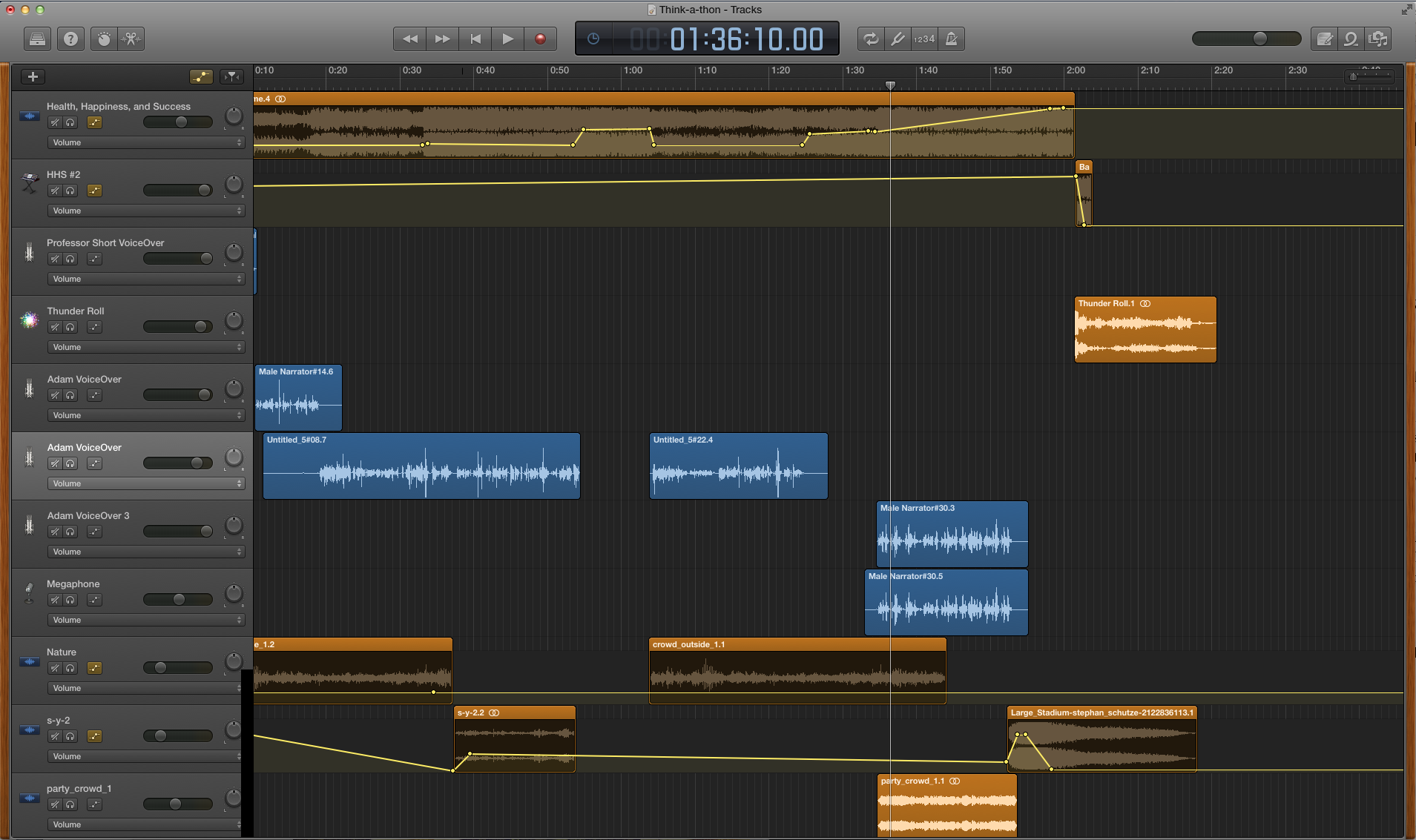
After this was completed, I then started to storyboard what these different scenes could look like. What resources do I have? What are my visual limitations? I am fortunate to have access to a beautiful campus so scenery was easy to come by and I had public spaces like the library which are generally accommodating to filming inside it. One limitation was that, even though I wanted to create a very social feel, I didn’t have immediate access to large enough groups of people that would really give the impact of scale I was going for. For instance, filming in classrooms is hard because it requires a talent release form at my institution. Because of this limitation, I wrote the script to be about the student getting ready for a big event and ending slightly before anything starts. The audience is slightly teased that an audience shows up but you never actually see them. This actually turns out to be a positive because in my own head I can’t answer what an event like this would inevitably look like.
For the look of the trailer, I wanted it to all be naturally lit and omit a significant amount of light. One thing I wanted to integrate was this idea of connected things together via twine. I would love to take credit for this idea but this was something I saw originally in a video by a spoken poet in Oklahoma City:
https://www.youtube.com/watch?v=wM_smbQAYv4
To get the effect I knew I would have to this shot either at sunrise or sunset. A buddy of mine has a really nice office that would work perfect for the idea as he has lots of knick knacks, books, etc. for which we could attach the twine. He has a big window that faces out East so we filmed this around 8:30am yesterday morning.
I then filmed for about three hours. Because everything had been storyboarded out and had such a structured framework, it came together rather quickly. I went from having nothing filmed to having the footage imported, edited, and exported by 5pm. Again, it came down to the process. In all honesty, I ended up spending more time thinking about my theory and conceptualizing a video than I did filming and editing. Which I think means the process work. 🙂
The last thing I want to document is my video editing process. I took advantage of this assignment to play with Final Cut Pro which I’ve never used at all. I was pleased to find out you can actually download a free 30 day trial from Apple. For the most part, I’ve used iMovie over the last few years so I was a bit intimidated going in, but I surprised to see how iMovie-like Final Cut actually is. One thing I wanted to was to created a sort of light leak effect for different parts of the trailer to put the sunlight effect I was trying to go for. I found this great free film burn files from Digital Cinema Foundry on fcp.co as well as this nifty video tutorial:
I used these files less for actual light leak, but more for the purple tint and grain, so you get that vintagey effect. For strong light leaks, I downloaded this free light leak pack from LightLeakLove, which is used at the beginning and end of the trailer and is slightly dispersed in between. The final Final Cut Pro project timeline looks like this:
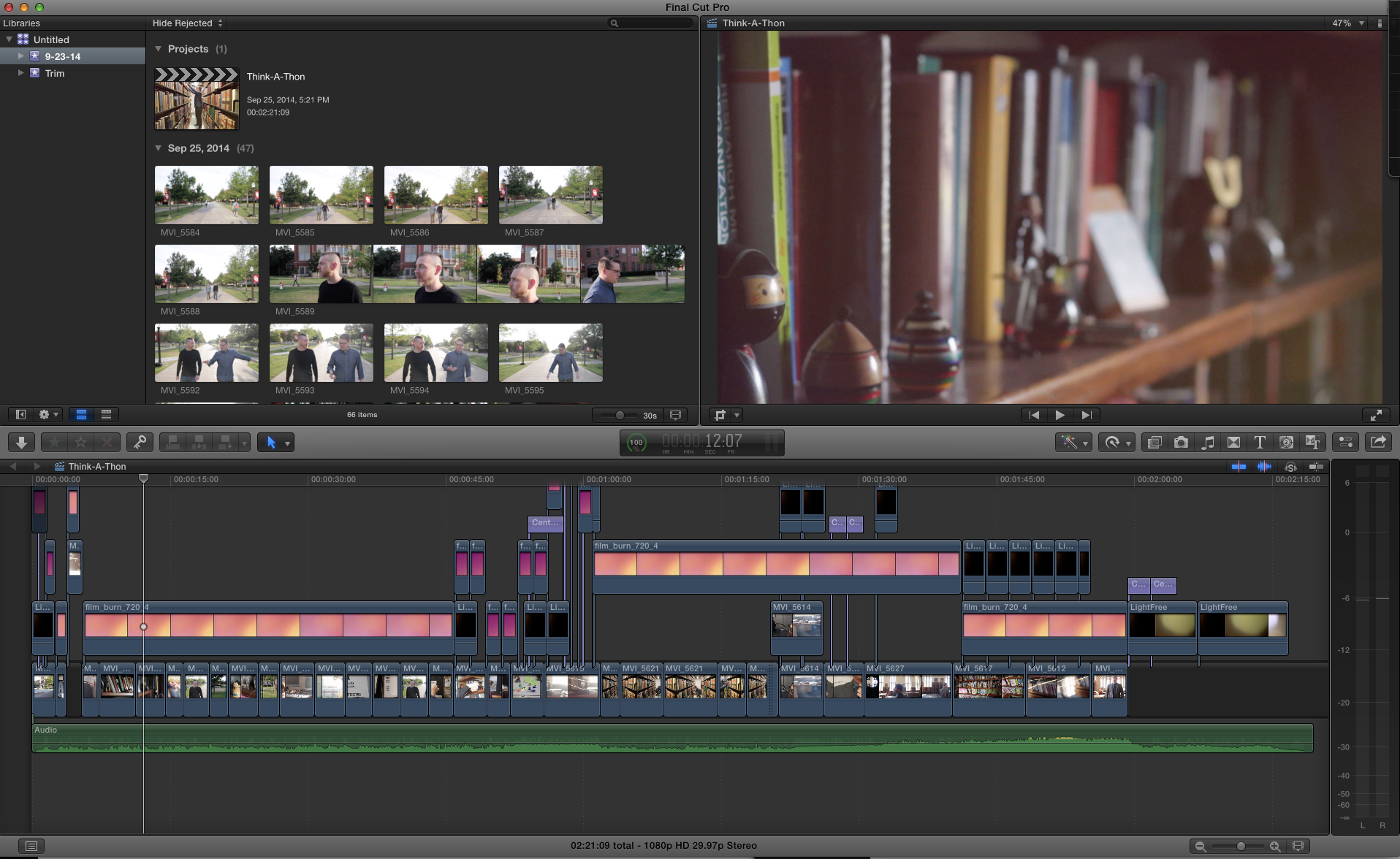
Overall, the biggest thing I got out of this is I can confidently say how I believe that people learned best. Analyzing my own process, I now realize that learning the tech was secondary and it made it more fun. Trying things out like a mic I had never used and a new video editing software didn’t feel like a vo-tech class where you are going through the motions, which is helpful for my research project. It felt like a challenge in the middle of the process. A bed of nails if you will.
3 Comments
Adam, you consistently put out some of the highest quality videos among a group of very talented cadre members. The level of detail you have recording in your process is incredible! Production quality, attention to detail and overall story are all top notch. Very well done!
Dude thanks so much man! I committed early in the process to not letting my blog just be a depository for final products but a place where I also take the extra time to document the journey. You only get one shot at this whole grad school thing and even so its half the time. In that regard, I want it first to be a reference resource for me with the the byproducts being (primarily) a place that the rest of the cadre can learn from and (secondarily) a place where outsiders can see the effort that’s being put into it. I don’t think I’ve hid very well that I love blogs and love the openness of the sharing. But, seriously, thanks for the comments. I’m glad to see others are finding the product valuable.
Adam, this was great, Think-A-Thon, where and when… I would come! In the future I will come to your blog for tips on how to film and blog my process. Thanks