Below is the script I wrote out for my final presentation that I gave on the Pepperdine West LA campus last week. A warning (and seeming admission): it was written at about 9pm the day before (whoops!). It’s raw. I haven’t edited any of it–just added some slide annotations and links. But I wanted to share it on the blog so it’s easier to reference later. Enjoy!
—
Hi, my name is Adam Croom, and I work at the University of Oklahoma in our teaching and learning center. I actually ended up in education almost by accident. During my undergrad, I studied Advertising in our Journalism School, J-School; Gaylord College. And I remember vividly during one of my final class–senior capstone–the deans coming and asking us for candid feedback on our experience. What did you like? What did you not like? What can we do better?
When I came back to work at the University a few years ago, I got an opportunity to actually give back to my school by adjuncting for a course. The course is called PR Publications (PR Pubs for short). To give you a sense of the course, this is a course within the Public Relations degree undergraduate sequence. It’s a junior level class and most would label it the technology course of the sequence.
The deans still go to all the capstone classes, and after teaching PR pubs for two semesters, the dean approached me with a problem. The feedback he was receiving for his visits was not good when it came to technology. Students said Gaylord College should offer more online courses (currently, we offer none). They said they want more opportunities to exercise their creativity abilities. They said they want more graphic design courses. More training. They felt as if they were entering a workforce with all the necessary conceptual theories and no understanding of how they could apply them.
So, being resourceful as we all try to be in education these days, he asked if I could help solve this. Can you take your course, PR Pubs, and turn it into an online course? For me this problem was a great opportunity. Here I am, in an online Master’s program learning in this environment. I have an opportunity to model for my school how I think online can be done.
So that became my question and my research. How do I create an effective online course? And I took a different definition of “effective:” in this case I wanted it to be an opportunity for students to feel more prepared for the workforce because of the course.
I had the building blocks of the course because I’ve taught this before face-to-face. But rather than port my materials to the LMS, I wanted to build this completely from the ground up, and I began searching for a framework to inspire the design of the course. I read the literature on technology integration within public relations classes, but unfortunately it came to me with the same problem: there was a disconnect between the classroom and the workplace, but this was a call for integrating social media. With this in mind, I made the decision that all the work would take place on a student blog. That they would leverage industry tools, like web domains and WordPress to construct, narrate, curate, and reflect on their work. I started reading Seymour Papert and constructionism and the idea that the computer should not program the child, but the child should program the computer. Students would build their learning space.
And then in December we read Mimi Ito’s Connected Learning Research Agenda and I fell in love with the ideas Ito had towards education. She advocates that her idea “Connected Learning” is realized when you are able to pursue a personal interest or passion with the support of peers and caring adults, and is in turn able to to link this learning to academic achievement and career success. I felt like I uncovered the common language in which I needed to drive my online course.
As I mentioned I had these building blocks for PR Pubs which are five projects. You design PR materials like business cards, letterheads, direct mailers, newsletters, etc. I decided that these five projects would each become their own cycle. And each cycle would be a different Connected Learning principle: peer supported, production centered, openly networked, interest powered, and shared purpose. For my research, I would try to infuse that specific project with that principle.
How would I evaluate what was taken place? Well I had a lot of blog posts. I decided that the way I would know that the students were indeed working on the course was that they would write a weekly reflection blog post much like what we do in MALT. I would then take the blog posts and code them with a tool called HyperResearch when the students were reflecting on different principles that I had embedded in the course.
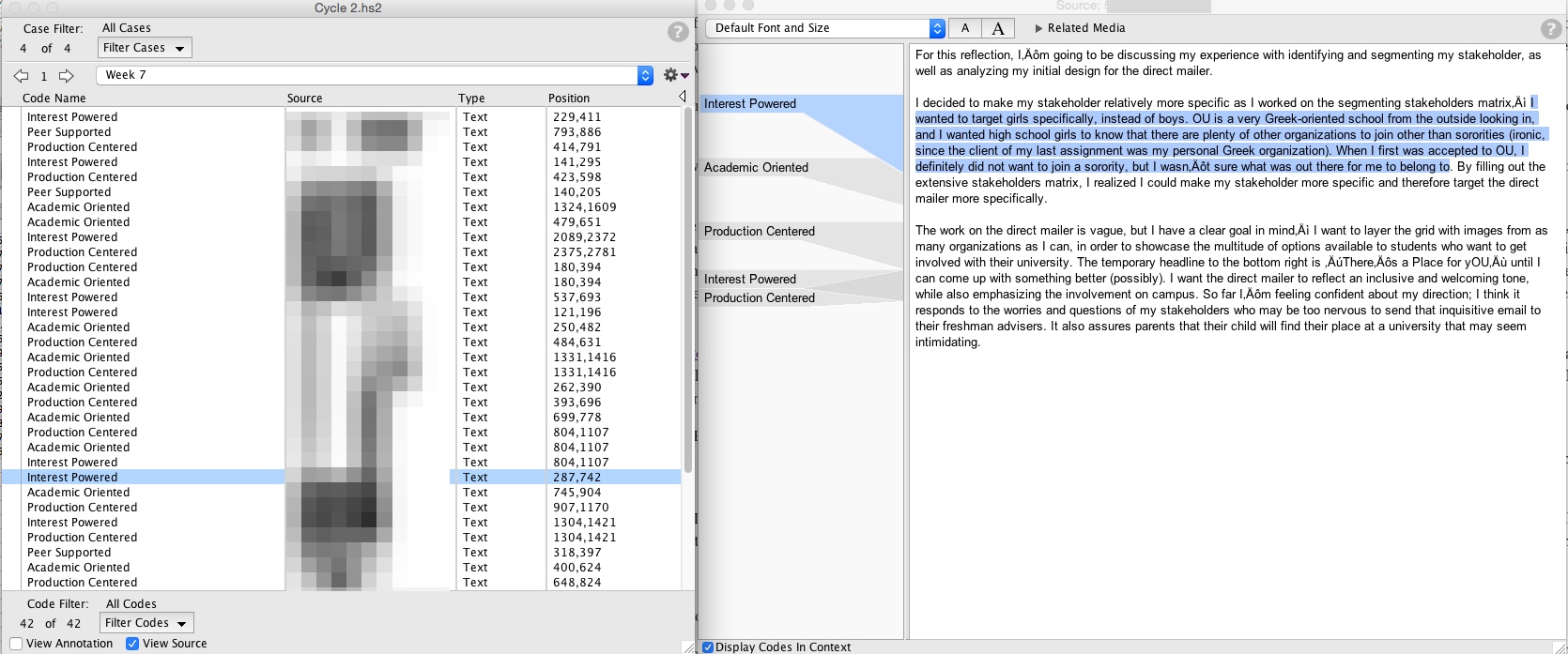
After they were categorized in the principle, I would dive deeper into that cycle’s specific principle. What were all the different ways in which they were referring to “peer support?”
I then took it one step further when I found a content analysis tool called Linguistic Inquiry and Word Count (or LIWC). With this tool, I could analyze the text against different special dictionaries that were created for different categories like social words, positive and negative emotion, causal words, cognitive words, etc.
So what does this look like? What happened and did it affect the course? I only built out Cycle 1 before the semester (the first four lessons or so). So this gave me room to make changes as I felt need from my students.
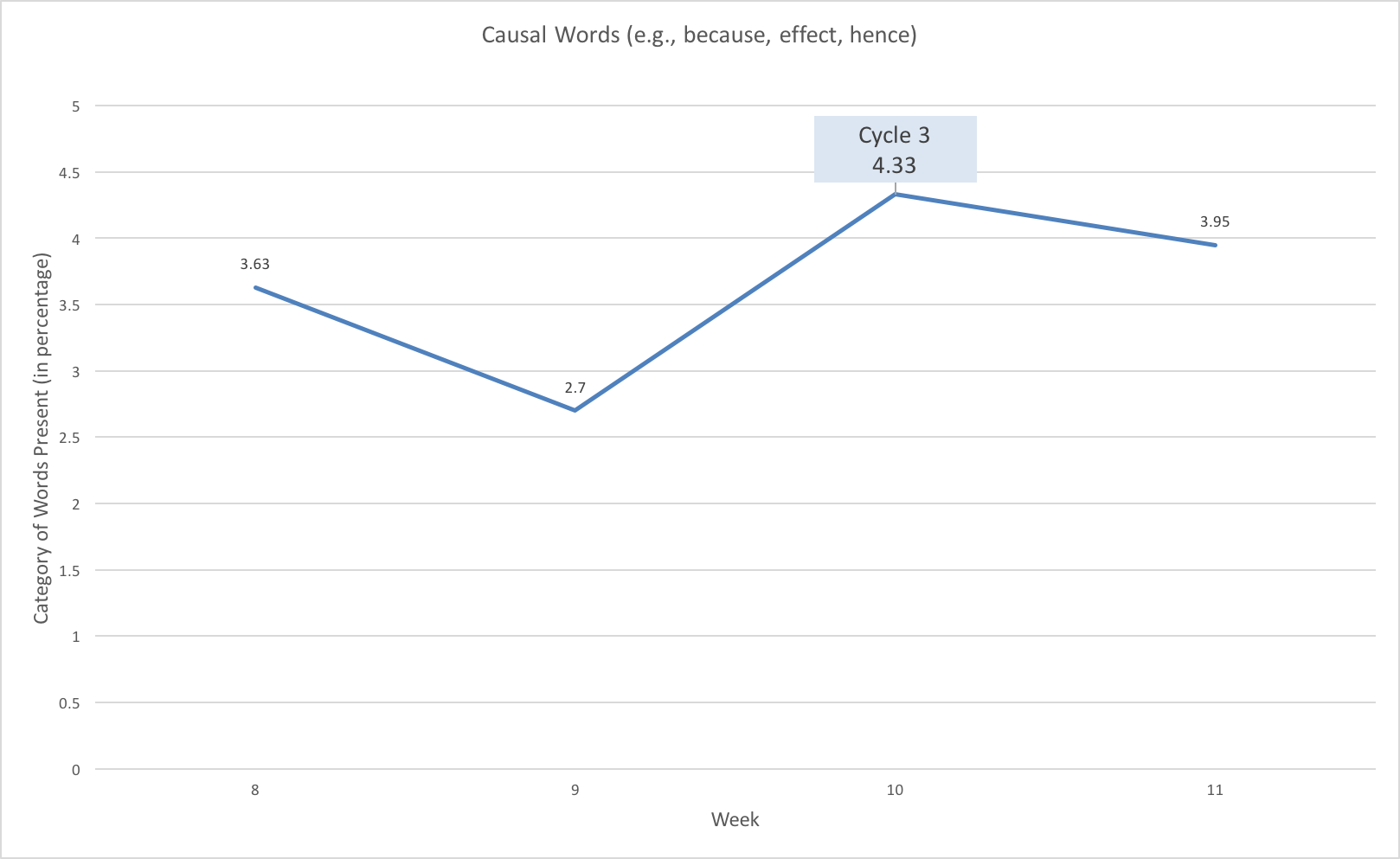
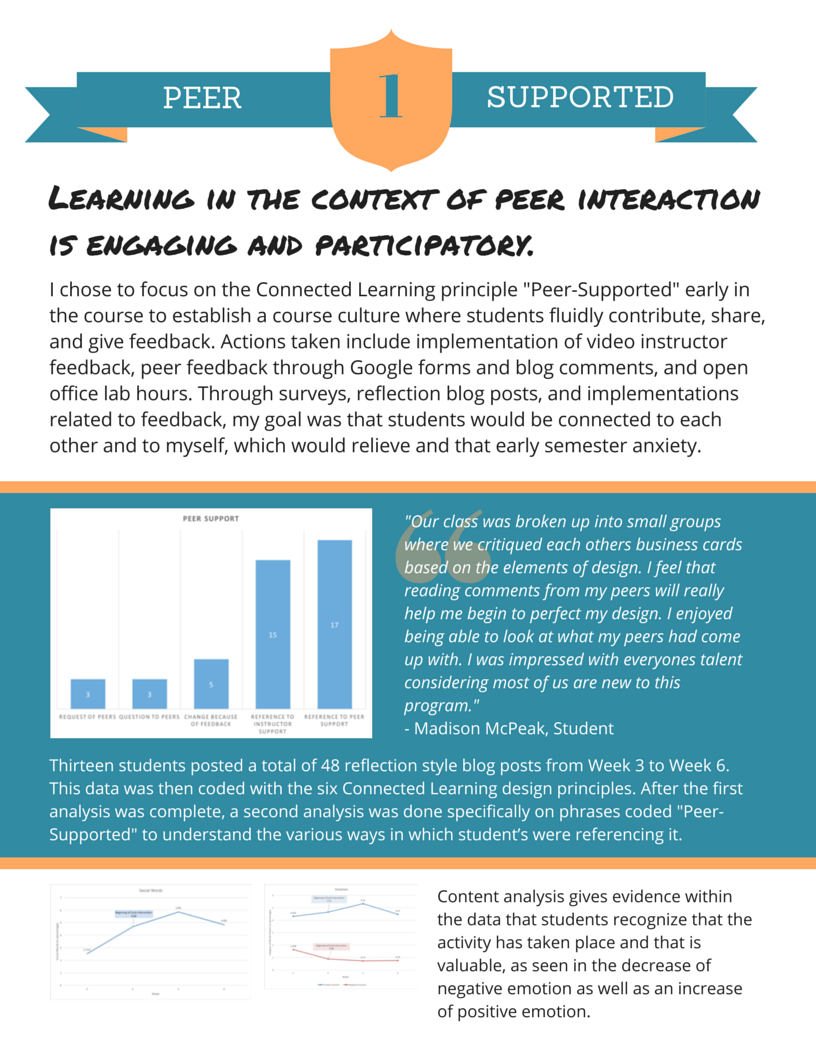
Cycle 1 was Peer Support and I had implemented a handful of feedback ideas: video feedback, open office/lab hours, blog commenting, anonymous feedback. I took away two big ideas: 1.) Students were leveraging blogs to actually talk to one another. They were requested more feedback. 2.) They reference a lot of interaction with me. I hadn’t thought of myself as a peer until this moment and I decided that I would assume the role of actually coming alongside them in the journey. The content analysis also was able to show me that the week Peer Feedback was implemented, negative emotion decreased: a positive sign that early semester anxiety was coming to an end.
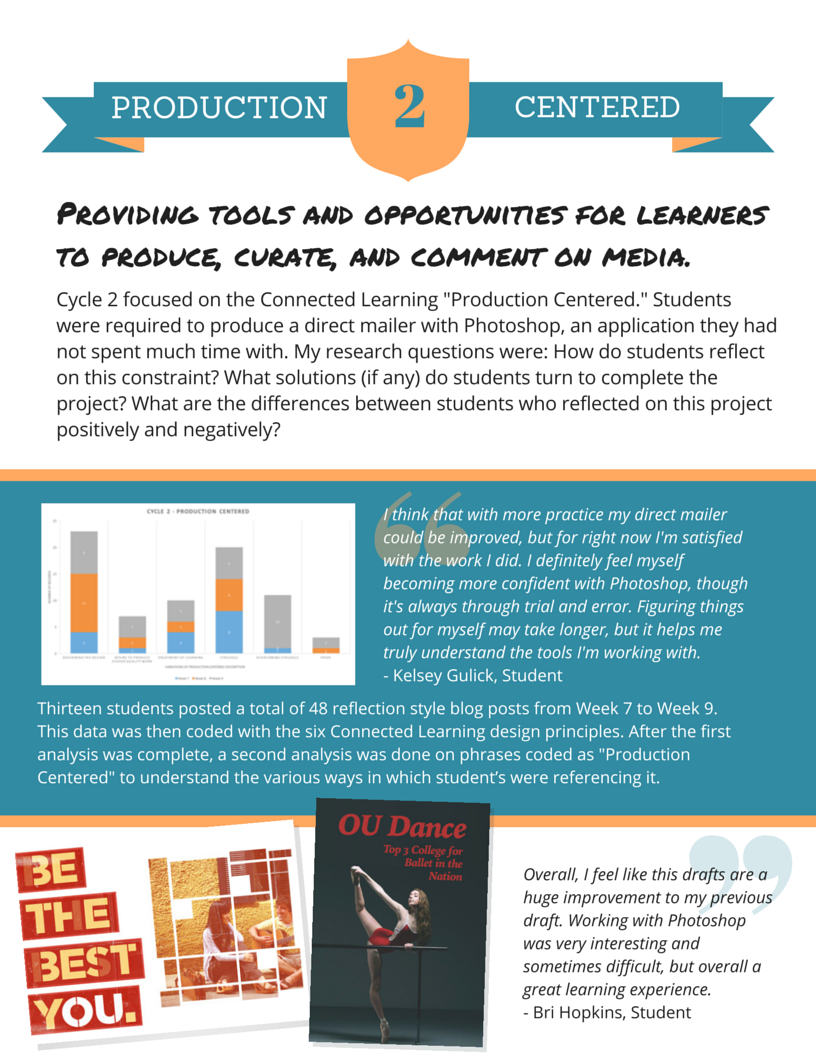
Cycle 2 was Production Centered and they focused on a brand new application Photoshop. I was interested in how they would attack understanding this tool and how they would reflect of the constraint of a new application. To be totally honest, during these three weeks I saw a lot anxiety and desire to produce better work than what they were.
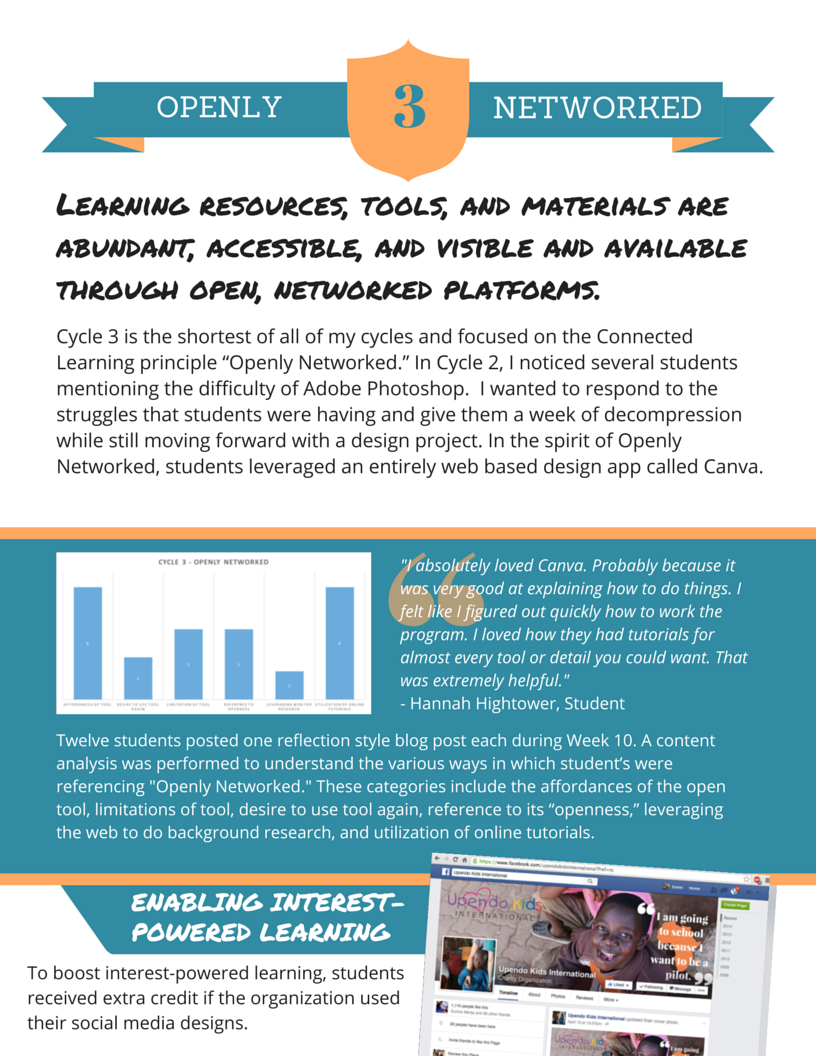
This guided Cycle 3 which was Openly Networked. I decided to give students a break from the big Adobe applications and assigned them to a new idea. They were going to complete a designed spring. Cycle 1 they had four weeks, Cycle 2 they had three, but this week they were going to have one. The catch was that they were going to use an application on the web called Canva, which is very user friendly and a quick learn. This was a BIG hit with the students, which was a real surprise. Students saw several applications outside the course where they could use this as it is much more accessible than the expensive Adobe packages.
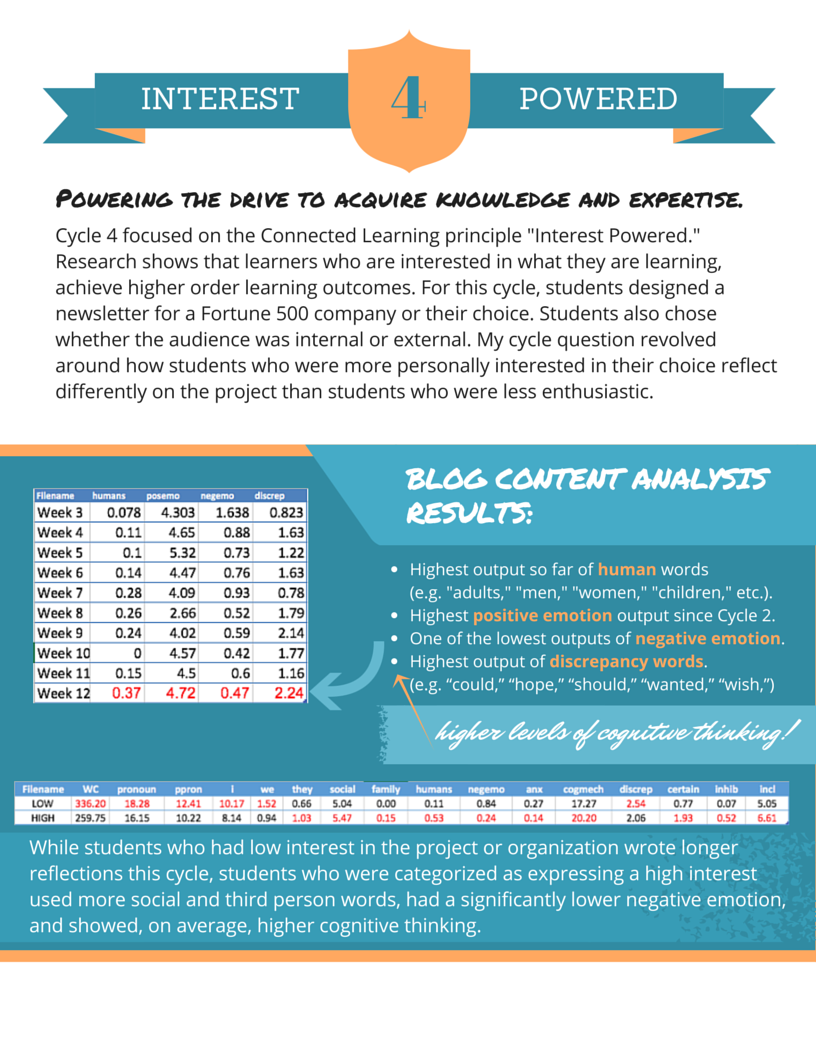
Cycle 4 was Interest Powered and they designed newsletters for the Fortune 500 company of their choice. I was hoping they would choose someone they were deeply passionate about. About half of them did, so I separated the two groups and ran the content analysis. I noticed that while students who had low interest actually wrote more, they used more first person. Students with more interest used more social words, had lower negative emotion, and used more cognitive words as well.
So that takes us to last cycle, Cycle 5, which just ended last week. I gave them the option to use whatever program they wanted to to construct what Alec Couros calls a Summary of Learning. Tell me what you took away from this class however you would like. Some different examples of Summaries of Learning are available on a Pinterest board. I have yet to really do a deep analysis on this cycle so my takeaways are slim right now, so instead I want you to hear it from one of my students:
The last thing I want to mention is my Wisdom Wall, which is an idea I got from Kristi O’Neil-Gonzalez, my cadremate. Students submitted wisdom for the next set of PR Pubs students and I want to read one that really summed up the student experience:
Dear Future PR Pubs Experimenters,
When I came into this class, I didn’t know what to expect. The only photoshop experience I had was one time I put D. Bo’s head on a Batman body. I couldn’t even figure how to create an InDesign document.
But that all changed.
I’m here to tell you that your greatest asset in this class is the time you spend inside the programs. It’s amazing how much you can learn by trial and error with design projects. Trust me, there’s a whole lot of trial and a whole lot of error.
It’s gets better.
I am asking you to tinker, to fiddle, to experiment, to delete and start over. Because, and thank goodness, when you finally get it right, you know it. You know that your design will achieve its objectives. And that feeling is amazing. To know that you have created something out of nothing and that it is good – that is when all of your time invested becomes worth it.
So all in all, put in the time, reap the rewards.
Happy experimenting!
– Cameron Morgan