I just finished Tom Peters’ the Brand You 50 and wanted to pen some thoughts before moving on too quickly to the Four Hour Work Week. I feel it appropriate to give a little bit of my perspective on Peter’s view point
In many ways, one could read Peter’s book and see me as the person in which is trying to write about. Let me explain. Right off the bat, “brand” is a term I think about often. My undergraduate studies were Advertising and I teach Public Relations. I have a simple definition of brand which is the collective opinion one has about an entity or a person. My idea is that you have a brand whether you want to acknowledge its existence or not and its up to you whether and how you cultivate it. But the general point is: Person A has an opinion of me (thats my brand) and Person B has a different opinion of me (that’s also my brand). For me, it has little to do with broadly scaling or amplifying what I do or say. It just is what it is.
I also enjoy really big projects. What Peters’ calls WOW projects, I’ve always called Ornery Projects. I like big projects and I’m highly motivated when I find an opposition to said project. In most cases, I use the opposition to fuel my desire to make the project better. Iron sharpens iron. And then I want to prove them wrong. As my mom would say, I’m fairly bullheaded.
I would also say that Peters’ would more than likely characterize himself as slightly crazy. It works for what he does. He reminds me of a pre-Seth Godin Seth Godin. I joked with my AR Learning Circle that I always read him with a sort of drunk slur in my head. Maybe he’s a drunk Seth Godin. But I seem to picture him as the guy I find myself next to who has had one too many and is trying to convince me to never get married, never have kids, and move to Europe. It’s so much better in Europe. To which I have to explain that I have both and am fairly planted where I am. But I digress, the point is I’m also slightly crazy. I’m willing to take a shot on ideas most people would turn down.
I’m also a big fan of what Peters’ calls “freaks.” I love surrounding myself with people of different view points. They are how I grow. Never in my life have I had a solid “friend group.” I tend to curate a loose network of people, most of which would never get along with each other, but that’s ok. It’s not my intention to build a social club. Just people I like to hang out with.
Next, I have loyalty to few entities. I may or may have not talked about this in my values statement but my loyalty usually lies to people who share my last name and very little further than that. My loyalties are to an ethos in which I want to live and to manifest themselves as projects I believe in. I learned this in undergrad when I had Roy Page, a CEO of midsize ad firm in OKC, as an instructor. In Oklahoma we have a lot of casinos and he talked about the decision as a company to not take casinos as clients. This is turning down a significant market in Oklahoma but Roy said he felt, while he wasn’t against gambling, he didn’t want to be a part of a system that perpetuated gambling habits as well. I loved this idea that you could say to clients you couldn’t sell. It was on that day that I decided that I would never work for an ad or PR agency as you could never just give me a product and expect me to “sell” it. I can’t do it. It goes against something deep within me. It feels almost physically impossible. Alternatively, I can sell anything I truly believe in. That’s an easy gig for me.
So here’s where I begin to struggle with Peters’ depiction of this ideal world of Free Agent Nation. To tie together the beginning of the Spring semester with where we are now, I had this conversation with my mentor. He characterized me as a Pioneer (versus being a Settler). This is an idea that was Wes Seeliger in his book, Western Theology, like so:
“There are two visions of life, two kinds of people. The first see life as a possession to be carefully guarded. They are called settlers. The second see life as a wild, fantastic, explosive gift. They are called pioneers.” (pp. 43-45)
Greg Selmon summarize’s Seeliger here:
These two types give rise to two kinds of theology: Settler Theology and Pioneer Theology. According to Wes Seeliger in his book Western Theology, the first kind, Settler Theology, is an attempt to answer all the questions, define and housebreak some sort of Supreme Being, establish the status quo on golden tablets in cinemascope. Pioneer Theology is an attempt to talk about what it means to receive the strange gift of life. The Wild West is the setting for both theologies.
I personally like this graphic that I came across.
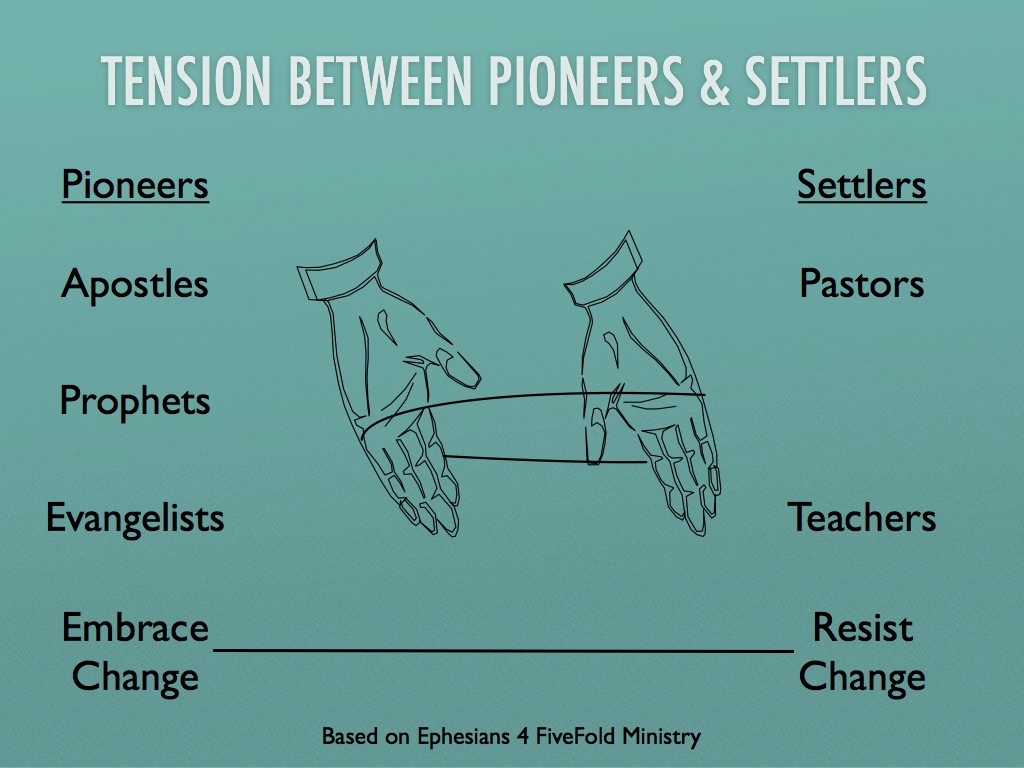
While Seeliger makes the argument for this happening within the church, I would extrapolate this characterization a little more broadly. This is the great American struggle.
My mentor and I talked about the issues of Pioneers, particularly those who are married to Settlers as I am. And the big issue I have that he nailed right on the head was Presence. Pioneers have problems with being present in situations which aren’t stretching them. My biggest downfall is mentally checking out of activities that I shouldn’t (i.e. time with family). My head is so far down the rabbit hole of the next idea I lose the opportunity to be with my family in the present. My head lives in a future world my present body has trouble keeping up with.
His advice to me was that for me to feel truly successful, I must work on how to present in all situations and let go of the Pioneer mentality occasionally and I agree. I believe this is the tension that arises in Peters’ idea of thinking of you as a sellable brand in which someone else can purchase. I’m not for sale. My Work Adam network needs to stay at a level that doesn’t interfere with Dad Adam and Husband Adam. My ability to provide for them consistently is very important to me.
And I write all this to tell this to myself as much as anyone else. I quit my first salaried job out of college six weeks end to become a full time touring guitarist for a band that didn’t have a tour planned more than a couple months out. My heart desires those types of opportunities while my soul understands that there is also beauty in stability and provision. I believe there is a certain level of tension that in America when we start to think of ourselves in terms of the value of our time. That value is elastic and significantly more valuable to those who dependent us.
So there’s my everyday battle. My addiction. I’m excited to jump into Four Hour Work Week as I’ve spoke to people about this idea before and already feel a stronger pull to the idea of how to do focus enough on what can provide an income so you can focus your attention more on what you love.