This week marks the end of what is called Design Project #1 in my course. Thus, it’s the formal end of Cycle 1 as well. There is one last piece that I would like to address, which is integrating different feedback techniques into the course. After this post, I want to reflect a little on Cycle 1 as a whole.
In my face-to-face class, I spend a significant amount giving assistance and feedback to students. The classroom is a lab, so I’m frequently circling the class and lending suggestions to work as they progress. For the online class, I obviously don’t have that luxury so built into the course design is multiple rounds of blog posts where they post drafts of their work. While it may not be the best idea, I began the semester with little feedback strategy. One question was how much feedback do students even want/need? Any at all?
As the semester has gone on, the anxiety and perfectionism that is expressed through the blog posts has helped answer my question. In fact, it’s over iterated what I feel is now my most important role. Instead of lead content distributor, I’m really lead feedback distributor. I’ve blogged earlier about how the student blog posts lead me to send students quick emails about how they were doing in hopes to reduce anxiety.
I decided that after they posted their first drafts we would do a round of peer critique. I had two main strategies in this one. I wanted to force peer-to-peer interaction as well as have the opportunity to practice some of the design language they have learned thus far. In preparation I looked mainly at three articles:
- “Peer Critique: Two Strategies for Getting Students to Give Feedback.“
- Linda S. Futch. “Cooperative Learning Groups in Online Courses.”
- Xie, Y., Ke, F., & Sharma, P. (2010). The effects of peer-interaction styles in team blogs on students’ cognitive thinking and blog participation. Journal of Educational Computing Research, 42(4), 459-479.
To make it slightly more manageable for the students, I broke it up into smaller learning groups. One of the ideas from peer critique was to have them submit anonymous feedback and then do public feedback, so I implemented a Google Form for them to anonymously critique work as well.
The anonymous critique was generally more structured feedback where the public comments seemed to lean towards overly positive feedback. I haven’t looked too closely, but I’m also interested in how this differed from the face-to-face and online sections.
After a round of peer feedback and emailed everyone a video screencast of me giving them feedback.
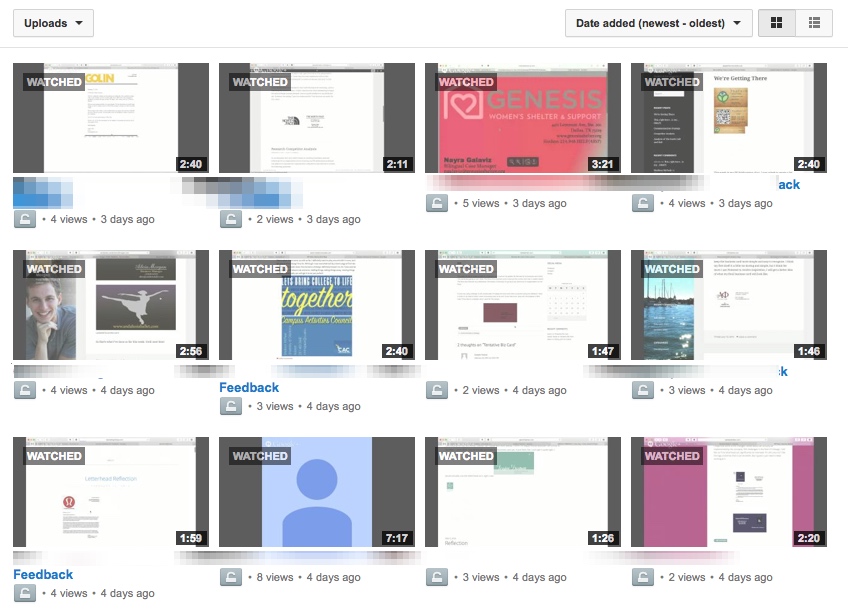
I only received a couple email responses to this, but I had two students come to my open office hours based off of this feedback. It was a really helpful way to give constructive feedback to those who really need the extra push. You can only say “YOU REALLY NEED TO PAY ATTENTION HERE” in an email so many times.
So what been the major takeaways? Good feedback takes a lot of effort. Particularly in an online format where you are trying to construct it through text, comments, videos, etc. But it’s also critical in helping settling the students and make them more confident in their work. More than anything, it shows them that you care and that you believe in what they are trying to accomplish.
With that said, I’ll take any advice on how else to analyze these three types of feedback: anonymous peer feedback, public peer feedback, and instructor feedback.
Other reads thats have influence my Action Research since the last post:
Jang, H., Reeve, J., & Deci, E. L. (2010). Engaging students in learning activities: It is not autonomy support or structure but autonomy support and structure. Journal of Educational Psychology, 102(3), 588.