I had a moment during the qualitative analysis of Cycle 4. This cycle I focused on Interest-Powered, one of my favorite Connected Learning principles. Since I’ve began teaching, it’s been my observation that students do better when you let them have some level of choice. In this cycle, students are to design a three page newsletter. They don’t even have to write the articles as I allow them to pull the articles from the company website PR section. Rather than focus this specific project on writing, I shift it towards having the students answer:
- Who is your reader?
- What content is valuable to them?
- How do you design with your reader in mind?
I let the students choose any company they wish as long as they are Fortune 500, and I use this stipulation because larger companies tend to have a more robust pool of press releases to pull material from.
So I went into this cycle thinking this is where I’ll see interest-powered come out. It will be shown in who they pick as their company and those who feel a stronger connection to that particular company will more than likely be more successful at the project. I would say this was a solid hypothesis.
But as I combed through my students blog posts for this cycle, I saw another interest-powered narrative begin to take shape. There wasn’t just a interest in who they were designing for how they were designing for. I mentioned in my last post that students spent Cycle 3 with a web app called Canva. Well Cycle 1 was Adobe InDesign and Cycle 2 was Adobe Photoshop. Well in Cycle 4, students are back in Adobe InDesign and I noticed there were some students who felt like this was a relief. It was a return to familiarity. To old stomping grounds. And to the students who this was important to, this drove an excitement for this project. It makes me think there is value in two places here: 1.) dumping InDesign for a few weeks. This really did stretch students to focus less on the tool and more on the process. And I really think this came out this week. Students were reflecting much deeper (in my opinion at least on their process not the tools process. 2.) Returning to InDesign. This also had its advantages as students were able to refine their practice and not go through a disorientation process that I saw particularly strong in the Adobe Photoshop cycle.
So the question is does the data support anything I’m saying? I’m going to work backwards on this post and talk about the content analysis piece first. I’ve built a table with some of the fields I found interesting in Linguistic Inquiry and Word Count:
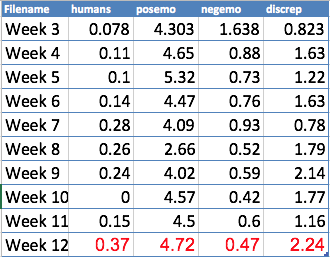
First, I saw the highest output so far of “human” words (adults, men, women, children, etc.). My guess is this has to do with students talking specifically who their reader is. Next I saw the highest positive emotion output that I’ve seen since the last week of Cycle 2 (Week 5). That’s a good sign because Week 5 was when they finished a very big project and had some pride in their accomplishment. It’s a good week to mirror. Conversely, I saw negative emotion drop to one of its lowest outputs. Last, I saw the highest output of “discrepancy” words. Discrepancy refers to words like “could,” “hope,” “needed,” “should,” “wanted,” “wish,” etc. Higher scores along the discrepancy dimension are believed to correspond with higher levels of cognitive thinking. This is fantastic news that points to this cycle being a pretty successful one in the eyes of an instructor.
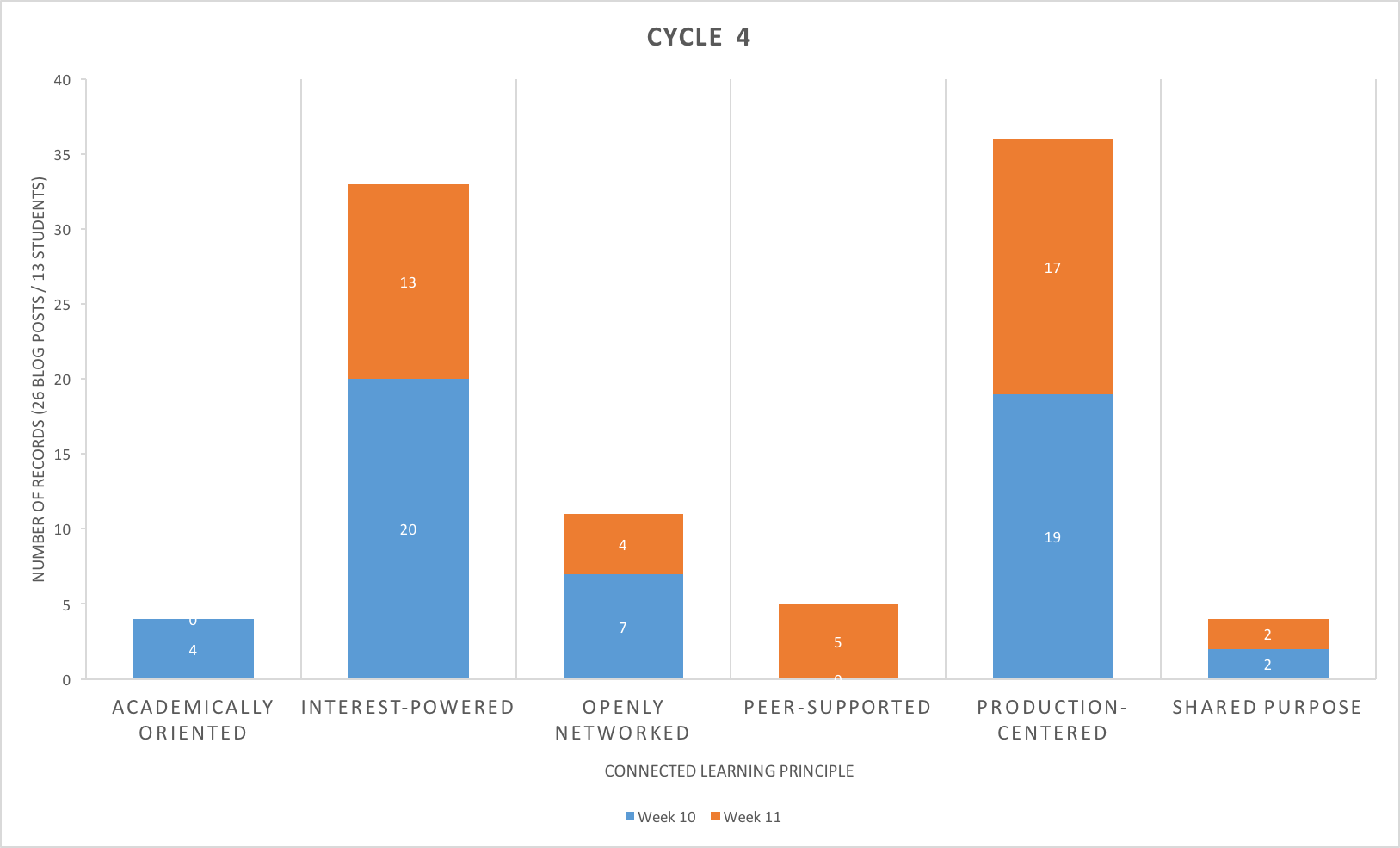
As you can see from the coded data, interest-powered really had a strong showing this cycle. After coding the connected learning principles, I went one step further and looked specifically at interest powered. I saw four themes: simply recognize that they chose something, recognizing they chose something that they were passionate about, interest in InDesign or the design process itself, and interest in the reader.
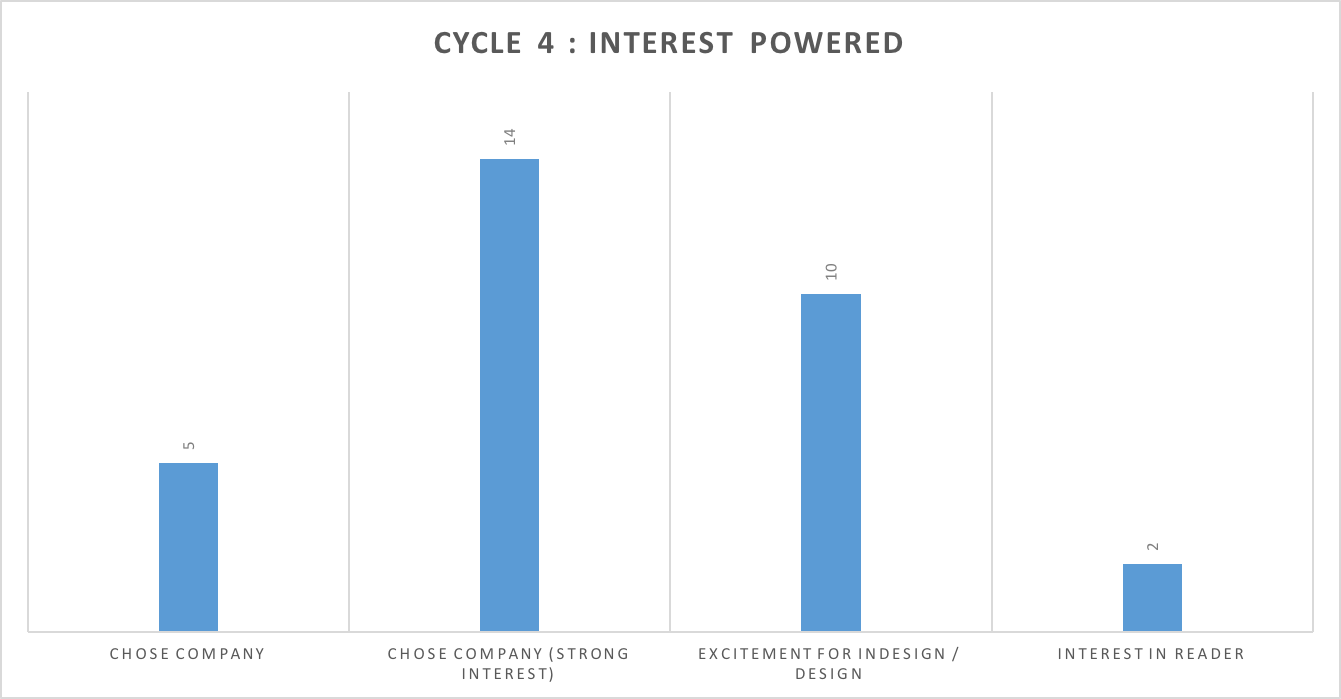
About two-thirds of the class chose a company in which I could tell they had a strong passion for. This made me curious to look at how those two groups stacked up against each other with the LIWC scores. So I re-ran those number with 5 students who appear to have just chose a company, and the 8 students who seemed more passionate. Below are the columns where there was a bit of a discrepancy between the two:

Students who expressed a lower amount interest in the company wrote more (average word count was 336 compared to 259) and had more usage of first person pronouns. Students who expressed a higher amount of interest used more social and third person words, had a significantly lower negative emotion, and showed, on average, higher cognitive thinking. The two groups were fairly similar with positive emotion, causal words, and insight.
My interpretation is students with higher interest are going to connect more of there work to their surroundings and most likely engage deeper in the open networks researching the company. They also more than likely had a very specific reader in mind. Lower interest students tended to be more self-reliant on this project and have a higher negative emotion towards the outcome.
As far as cycles go, this is the one where I feel like I’ve played with the data a lot. I keep finding myself looking for trends and how to interpret them. This blog post ends up only being a snapshot of some of my ideas. But I leave this cycle more interested in how to do activate interest in work. It helps to give them choice but I really want to activate is the interest in learning and want to explore in future offerings of this course how I can do that.