Cycle 3 is the shortest of all of my cycles. As I mentioned in my last post, I have been noticing several posts from students on the struggles of learning Adobe Photoshop in particular. There are several reasons for this, one being a few snow days on campus, but as I’ve thought more about what Adobe Photoshop is, the truth is its not a 21st Century designing platform. It’s an operating system. Photoshop CC can do everything you need down to the pixel and it’s incredibly powerful, but its also bulky and bloated after being updated so much (I believe this is the eighth version of Photoshop). Don’t get me wrong, Photoshop can do it all now! In fact, I found this really funny video the other day of designers trying to use Photoshop 1.0:
But I wanted to respond to the struggles that students were having and give them a week of decompression while still moving forward with a design project. I had had on the books an infographic assignment for Cycle 3, but I felt that it would be better to shift to something a little less research and design intensive. I had ran across an online application called Canva a few weeks back and was impressed by its ability to hold its own for a cloud-based app:
https://www.youtube.com/watch?v=XqYti78riU8
So I decided the openly networked cycle would focus on how students would utilize this open tool. My questions for this cycle were as follows:
- How would students learn the tool differently? Would it involve tutorials or just play?
- What other connected learning principles would be activated by this tool?
- Would students react positively or negatively to this diversion to the web?
Since this cycle was only one week and students only wrote one reflection blog post, I don’t have a ton of data to show a narrative over time. But I did code the 12 student blog posts with the six connected learning principles as students identified them in the project:
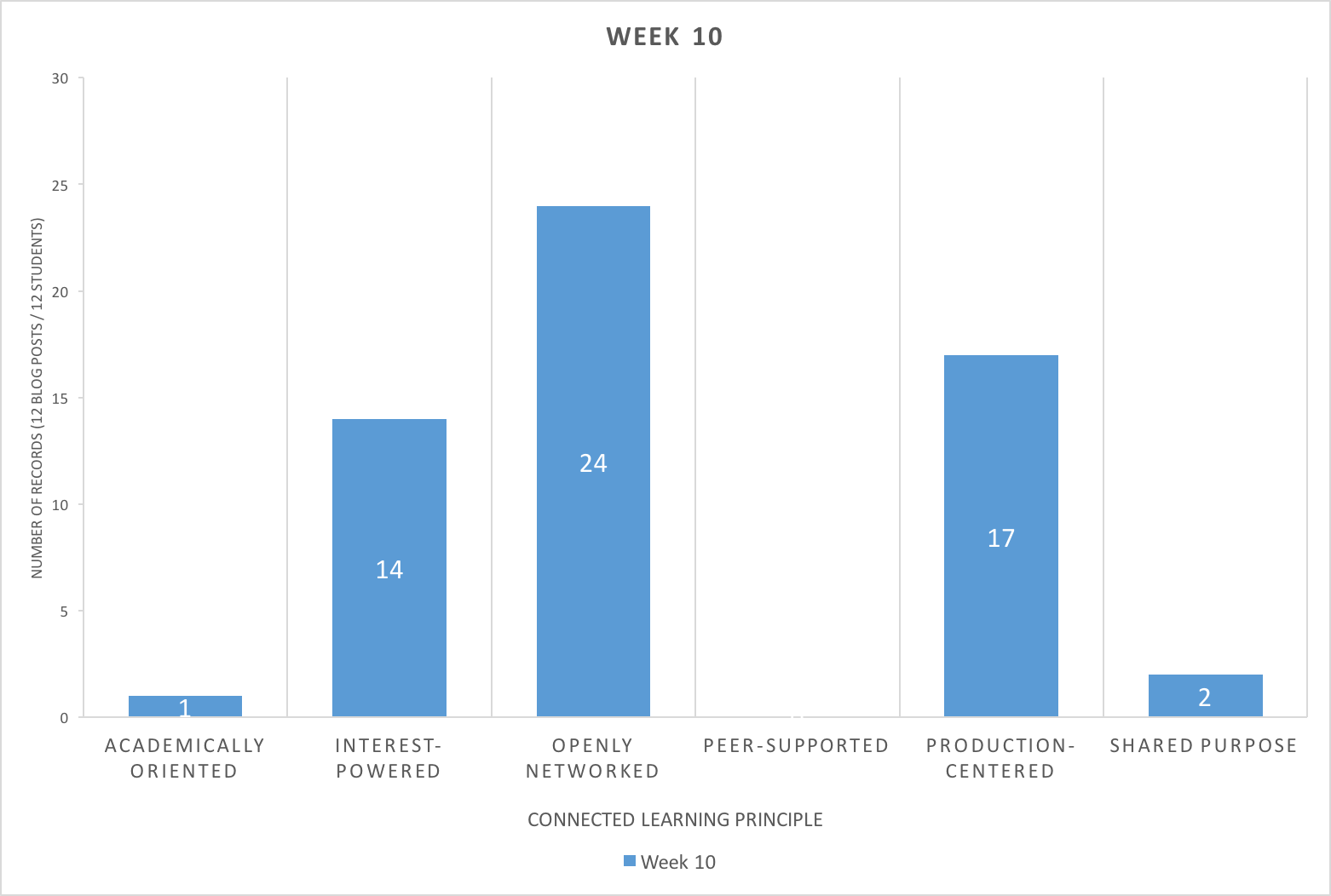
The hardest part for me was deciphering openly networked versus production centered this week as those tend to blur together. As best as I could, I tried to code students talking about the act of production. Example:
“For the Facebook post, I decided to use a textured grass background. I figured that it could remind the customers of the feeling of grass between their toes”
I coded openly networked into two buckets: the Canva tool and the broader web as a general resource for learning. I landed on the following categories: affordance of the open tool, limitation of tool, desire to use tool again, reference to its “openness,” leveraging the web to do background research, and utilization of online tutorials.
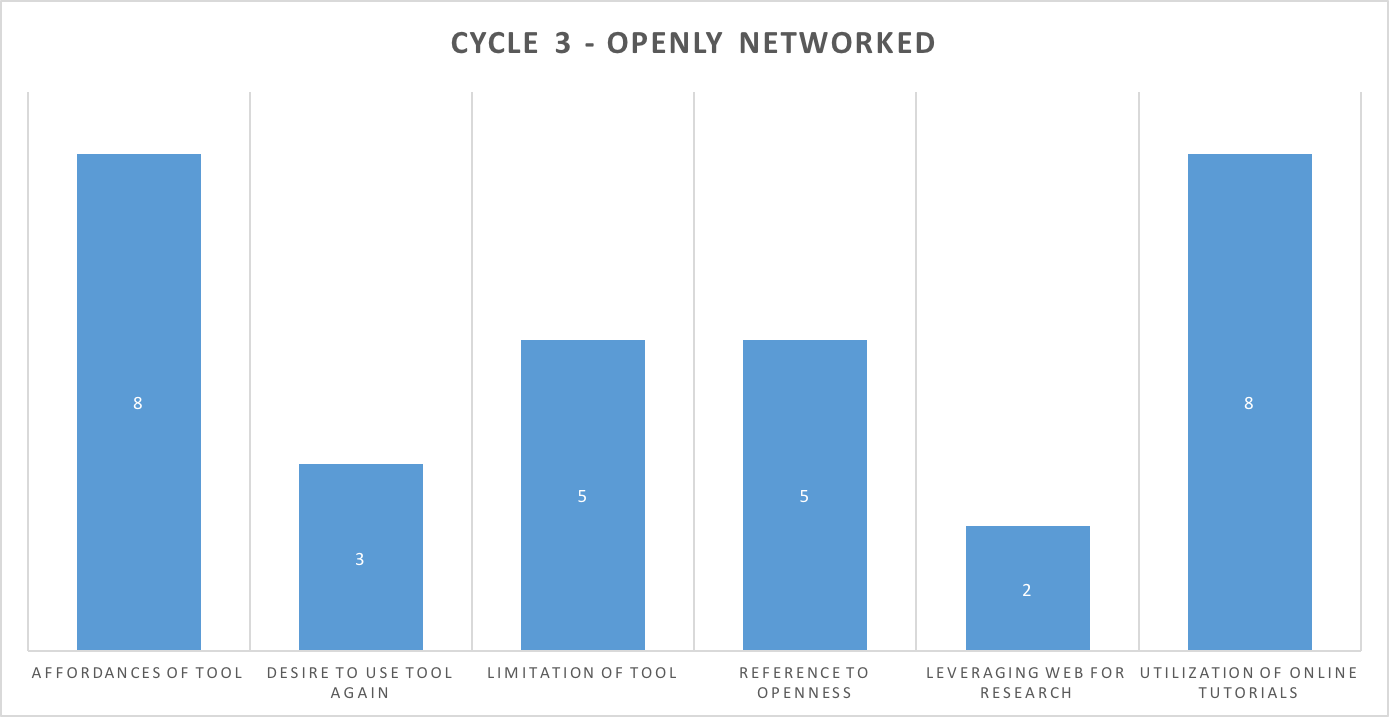
Additionally, I did a content analysis with the LIWC tool to see if there were any major differences in categories such as positive or negative emotion, cognitive mechanisms, social words, etc. After looking at the data of the previous week to this cycle and the following week, I would say there is no positive correlation of a spike in positive emotion (or really a spike in many of the categories). The one jump I saw was in causal words (because, effect, hence):
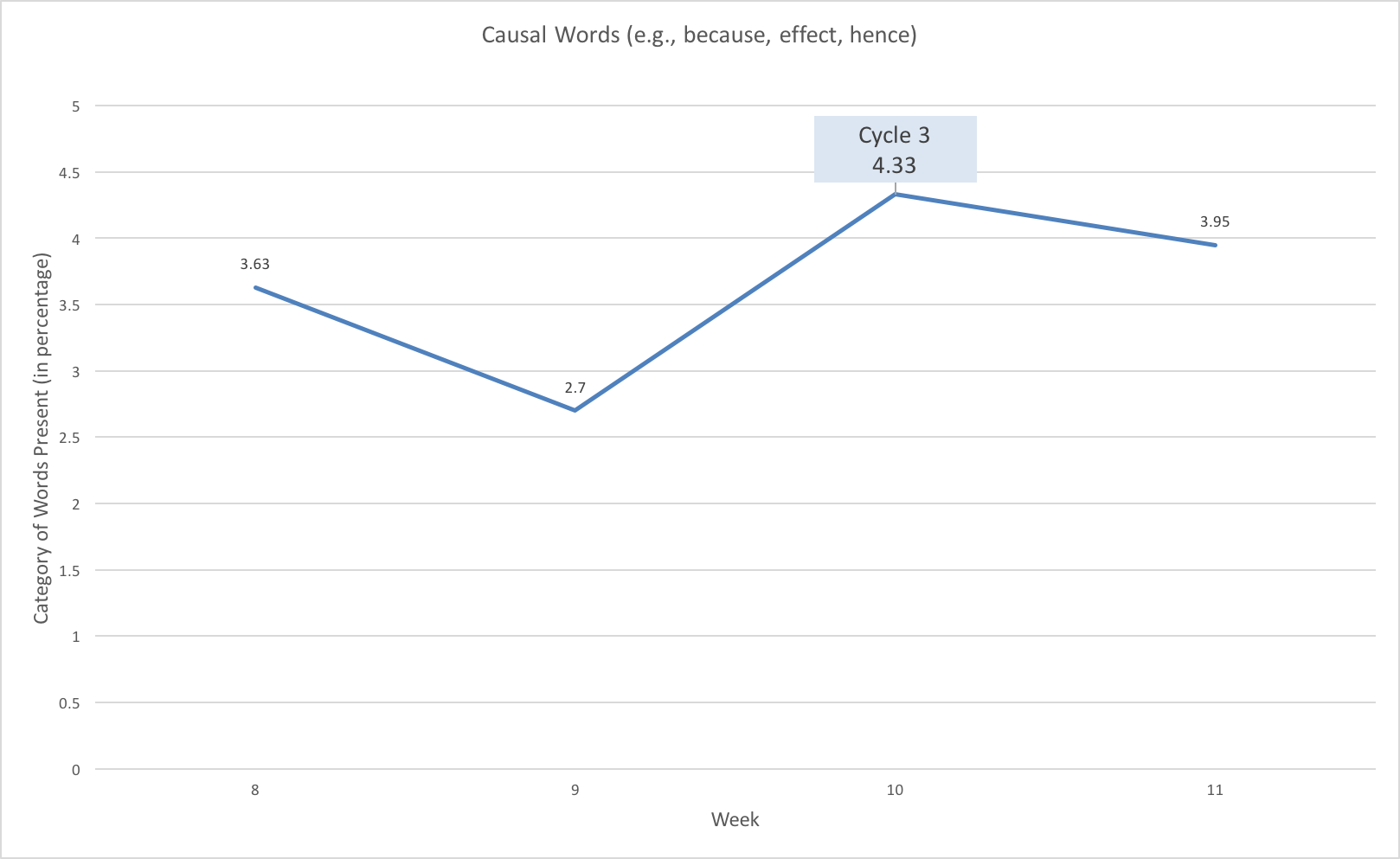
In my research I found it argued that causal words are used in the extreme situations to create causal explanations and to organize the participant’s thoughts. As an instructor, I like that students aren’t just explaining what happened but why it happened as well.
Some of my reflections from this cycle:
- It’s funny because when I read these they seem overly positive about the experience, yet the data doesn’t show an extreme increase in positive emotion. That wouldn’t have been my guess so I’m glad I’m not looking at the data from only one direction.
- Moving to an entirely open network definitely has affordances but students were quick to recognize the limitations as well (only portions of it were free, you didn’t have the same amount of freedom, templates limited creativity, etc.) I was at a conference last year where a speaker said “Open is free the way a puppy is free.”
“Open is free, the way a puppy is free,” on maintaining and sustaining OER #cnx2014 #jasonpickavance
— OpenStax (@OpenStax) March 31, 2014
This makes a lot of sense. We all like the free web but the web has its own constraints as it tries to build web apps that can be limited by processing or bandwidth speed. - I saw a lot of students saying they wanted to come back and use this again. This isn’t a comment I heard with Adobe Photoshop or InDesign early on. In my face-to-face class, a student talked about it as a way for their group to design on the web collaboratively. Openly networked is appealing as almost a reference or safety net as much as anything else. There’s an assumption that it will always be there.
- Openly networked can be paired with tutorials and scaffolding really well. One thing I saw a lot less this time around was the fogginess of learning a new tool. There was a consensus in the “ease of use” and I think ti had to do with how quickly students were able to latch to the tool.
- Last thought: One week cycles are much easier to process than six week cycles. 🙂 This is also the first cycle where I feel like the previous cycles greatly influenced what took place this time around.