For the last two weeks, I have been tracking all my work activities as part of an assignment for the Cognitive Tools course. We were asked to analyze the “Why” of every activity as an exercise on reflecting what Simon Sinek says about motivation in his book, Start With Why.
This was an enjoyable activity for me as I tend to really enjoy reflection. I’ve also been mildly intrigued over the last couple years about the quantified self, so this was an intriguing exercise in qualifying the quantified. In similar activities, such as wearing activity tracker or keeping a food journal, I’ve found that it always leads to a more comprehensive reflection of why you do (or did) certain activities.
Being that I’ve have short term enjoyment with tracking apps such as Up or LoseIt!, I decided to go on a hunt for one that could similarly track what I was doing. Somewhere in the last year, I vaguely remembered reading about Nicholas Felton who visualizes each year of his life since 2005 as an infographic.
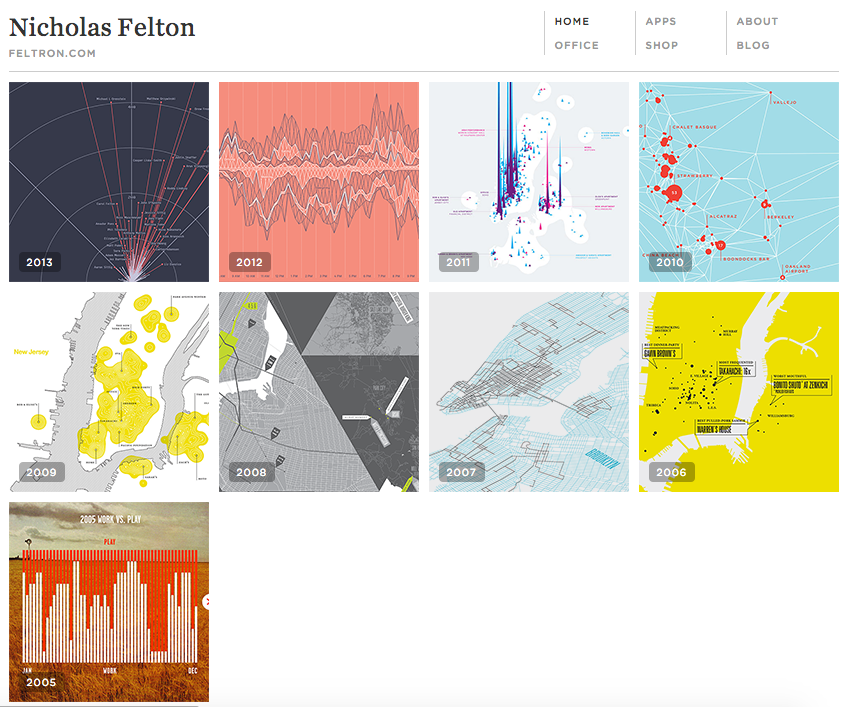
I also remember it mentioning that he’s recently developed an app to do this sort of activity. After a 15 minute Google scour to recover the article I had read, I landed upon Nicholas’s website.
I downloaded the Reporter app and started checking out all it had to offer. Reporter is a fairly simple app that gives you a quiz at whatever interval you are interested in. You can customize the questions to your liking as well and then it will visualize your data for you. The best part about the app is your data does not leave your device and you can export it in a nice little CSV file at anytime, which was very helpful for this assignment.
To give you a summary of my process, I decided to report as often as possible on work days. This included pre and post work activities. Days that aren’t included are weekends and a couple of odd days were work was cancelled due to winter weather. Part of what I wanted to understand was the “why” of my life hostically, which meant looking at how spent time on the two activities that consume my time BEYOND work: family and grad school. Because of this approach, my data is potentially a little more custom tailored than others.
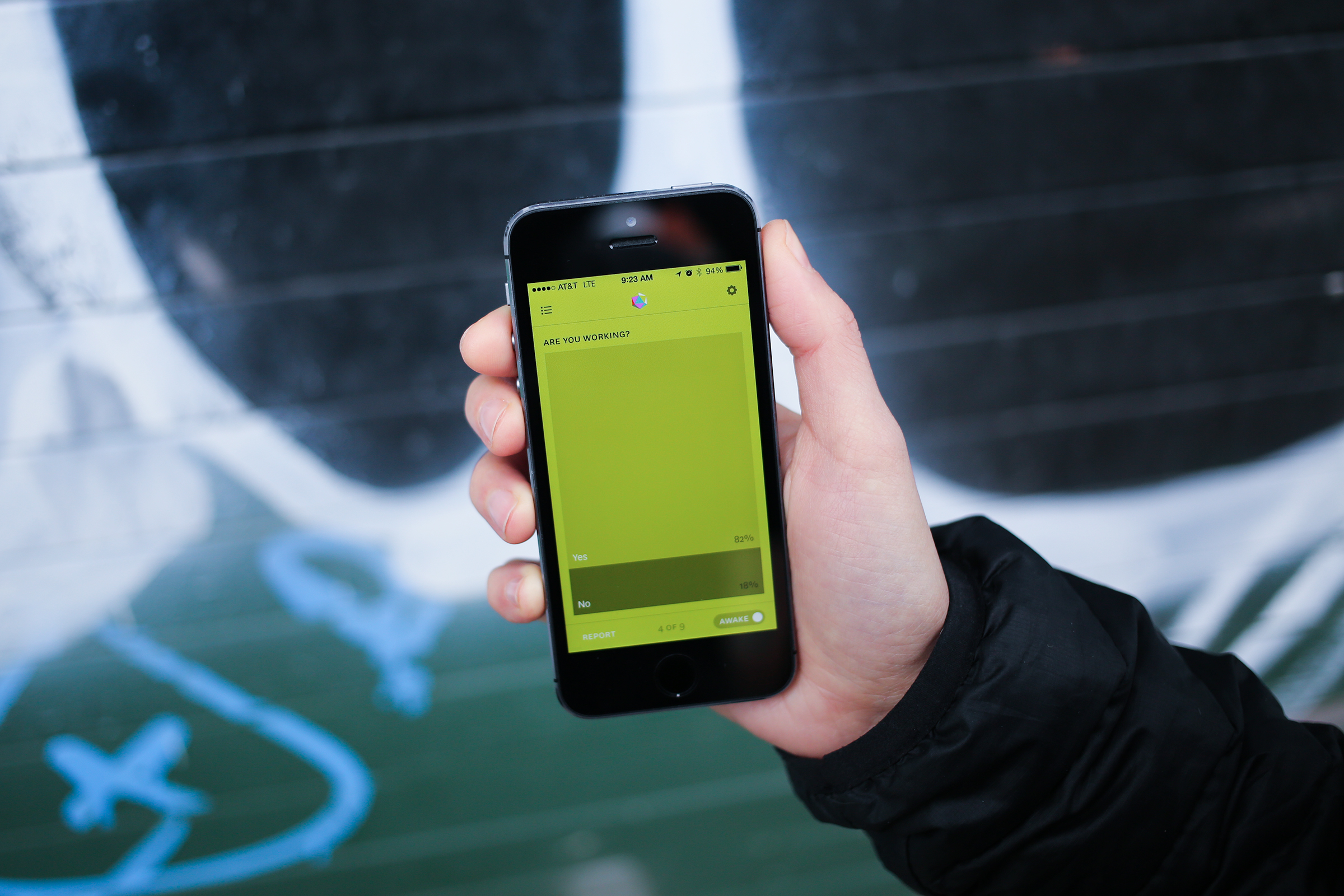
So how did it go? From February 24 to March 4, I “reported” 44 different moments. An example of a report is below:

Each report is timestamped with date and time, location data, weather data, photos added since last report, audio decibel level, steps taken since last report, who I am with, if I’m working, and the name of the location.
The “why” reflection didn’t take place until now (which is an interesting reflection in-and-of-itself). I noticed that even recorded this small amount of data (where several parts are automated) was still a significant amount of work at times. For the why, I categorize the data into five categories: Job-Related Meeting, Job-Related Meeting (in which I’m leading), Instructor Related Activity, Grad School Activity, Spouse Dad Activity, and No Relevant Category (this usually included non-meeting or family meals, doing job activity at my desk, buying stuff on Amazon, etc.). One of the troubles I had with the assignment, is that I feel that I wear many hats to my personal why and simply looking at my team’s “why” inside the organization felt too narrow for a personal evaluation.
According to the data, 22.5% of my activity was in meeting I wasn’t leading, where 12.5% was spent in meeting I was leading, 12.5% of my activities were related to teaching, 7.5% was related to grad school, 25% was spent doing spouse/dad activities, and 20% did not fall into any category.
Below are some responses to questions Bill seeded in the Moodle instance:
- What is the “why” that drives your organization, unit, etc?
In essence, I would say that the “Center for Teaching Excellence” exists because instructors, or–as Vygotsky would say–a “More Knowledgable Other”–are essential to the learning process. - Is the “why” central or peripheral to your organization’s activity?
I would say it definitely is. Because my organization is made up of academics, it tends to be deeply reflective on what value we are bringing to faculty. What I mean by that is there is a constant evaluation of education and pedagogical techniques and many conversations centralize around purpose. - What is your personal “why”?
This one I have a bit of a head start because we wrote a personal mission statement for Design: “My mission is to present the best possible environment for learners to spark their creativity and advance innovation through experimentation and exploration.” But that’s very much the WHAT. My WHY would simply be experimentation and exploration. Those are core for why I want my classes to be laid out in the manner in which they are. Students learn through becoming self-directed. - How does your “why” align with your organization’s “why”?
My hope is that instructors cultivate an environment that allows for creativity, experimentation, and exploration. I believe these are integral within research but probably don’t touch the classroom experience enough, mostly because we tend to hung up in areas like assessment in which we want more measurable results. I get concerned when we are doing too much development through rigid frameworks. Additionally, I think we could have more learning opportunities FOR faculty that happen through experimentation and exploration. Because of the weight of student evaluations, faculty tend to not experiment too much. - How does this alignment (or lack of) contribute to your work, and your feelings about your work, effectiveness, etc.?
I’ve have discussions with my boss in regards to how to support more progressive classroom techniques and continuing to search for ways in which we can integrate these with faculty. While I feel that our WHYs are aligned, I know my personal WHY is not coming to fruition in the majority of our courses, which can feel overwhelming feeling at times.
Reflecting on these questions and then looking back at my activity the last couple of weeks, I see my personal WHY reflected in my teaching, my grad school activities, and some of the meetings I’m leading. Other activities feel a bit administrative and assisting in seeing through someone else’s WHY. While these may not be aligned at all times, I feel a very important characteristic of an educational institution is this collective respect for multiple WHYs and view points. Broadly, we want students to cultivate a passion and that has many endpoints. In a similar vein, I’m happy to be in a position where I have opportunities to lead a classroom in the manner of which I find closest to my WHY, while also supporting other people’s WHYs.