When a real, once-in-a-lifetime change comes along, we are at risk of regarding it as a fad, as with the grown-ups arguing over the pocket calculator in my local paper. What they should have been arguing about instead was how to prepare students to take advantage of the new tools, but they got distracted by assuming that because calculators were new additions to society, they were also provisional ones, when in fact they were new but permanent. – Clay Shirky, Here Comes Everybody
As I finished up Shirky’s book, this was one of the last points that he made and it’s a good place to end. We are far beyond the example he uses of the calculator. “Solutions” exist for every problem, discipline, and exercise imaginable. One thing I struggle with, as a technology steward as Wenger would say, is how teach people how to filter out the noise (including myself). A couple examples that I’ve ran across lately that show interesting sides:
1. Mobile
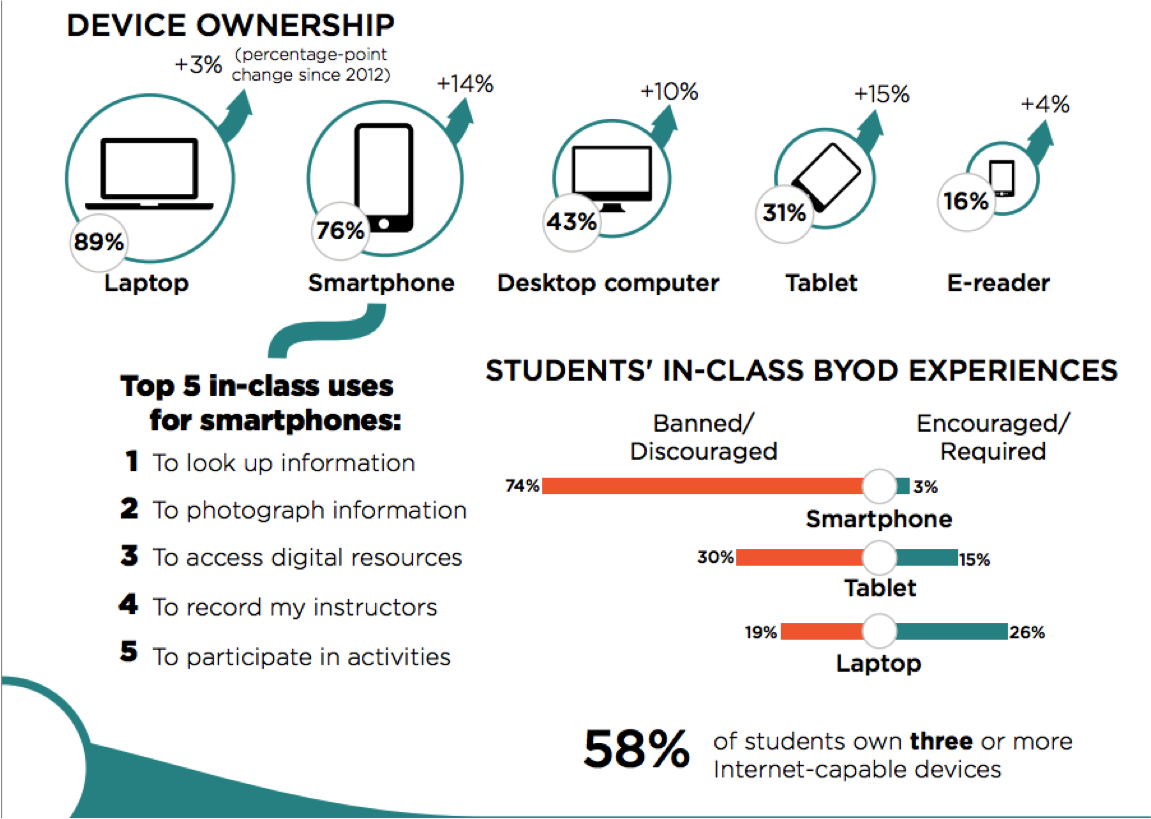
This is a slide I use in a few of my presentations. Notice the rapid adoption of smartphones and tablets in the classroom, notice the incredibly valid use cases that students have for them, and then notice how much they are banned and discouraged. 76% of higher education students have them, 74% say they are banned are discouraged (even Shirky himself has banned them). Needless to say, this seems off.
This has troubled me since I first read it. But after reading Shirky, I’m starting to piece together why this may be happening. We’ve been in this mesmerizing phase of the smart phone since Jobs released the iPhone in 2008. We expected mobile to woo us more than anything else. It seems more and more there’s an almost negative reaction to a new model to the point where it’s culturally applauded for not conforming to Apple’s latest and greatest (at least in the short term). The issue with this is we end up judging the technology as if it’s fashion coming down the runway, while completely miss the fact that better technology is getting in the hands of the world and the thinness of it doesn’t really matter. Almost two thirds of the worldwide population is predicted to have a smartphone with internet access by the end of the decade. At what point do we let mobile devices be tools rather than accessories? I loved Shirky’s quote that touched on this:
Communications tools don’t get socially interesting until they get technologically boring. The invention of a tool doesn’t create change; it has to have been around long enough that most of society is using it. It’s when a technology becomes normal, then ubiquitous, and finally so pervasive as to be invisible, that the really profound changes happen. – Clay Shirky
That was the moment when I realized we are getting there. We are transfixed by one-to-one tech programs, tablets, and the like and we are closer than ever to seeing it just become a tool. But first, we got to let go of it being cool. I guess the big question is when does the consumerism market and its tech blogs let the release fall back into the fold? Or does that have even have to happen?
2. 3D Printing
There’s a quote that touches on similarly with 3D Printing in Stager’s book, Invent To Learn, which we are reading for our design strand. But it actually attacks it almost as a word of caution:
There is every reason to suspect that as 3D printing becomes more widespread in schools, you will start to hear sales pitches for products “designed for learning.” Be wary of such claims. Attempts will be made to turn 3D printing into a teaching technology. There will be claims that teachers can print out “learning objects” for students such as 3D models of the human skeleton, molecules, or historic buildings. There will be professional learning workshops where teachers will be taught how to use a 3D printer and given a list of how to integrate 3D objects into their classroom. These efforts should be banished from the building. 3D printing is a creative learning tool only in the hands of the learner. – Gary Stager, Invent to Learn
Again, 3D printing is a kind of romanced type of technology currently that appears to offer a glimpse into the future. I’m not sure exactly how he sees this playing out and wish he would have expanded a bit more, but Stager’s point seems to say that we need to watch out for it as well and approach with caution. The device’s seemingly endless applications can look like a goldmine in a capitalist society. Is it part of the cycle for technology to go through this period of trying to be a solution for education first? Steve Jobs was smart enough to be a pioneer in this space by marketing early Macs to university researchers and K-12 efforts.
If the pace of technology is accelerating, and it is true that technology must go through a very commercial “technologically boring” stage, I’m curious if this hype cycle is also being accelerated OR if the commercialism of technology is so prevalent that its actually decelerating. Though this doesn’t feel like an incredibly coherent thought, this feels like a good dissertation topic!
I’ve really enjoyed Shirky and will probably pick up a copy of his latest book Cognitive Surplus when I gain my life back in August. Its amazing to think a book that published in 2008 has missed some big technologies. Shirky acknowledged that Twitter was launched during the research of the book and there’s nothing on smart phone app development. He’s definitely an interesting guy that I feel I’ll be following for quite some time.